
New developments make heat pumps usable in a wider range of temperatures and applications
11/25/2024
Heat pumps have found growing popularity as a high-efficiency solution for cooling and heating. With greater public awareness and organizational emphasis on sustainability, these systems are a viable upgrade to a wide range of processes, from residential climate control to industrial heating and cooling applications. The flexible functionality of heat pumps – namely their ability to reverse the traditional vapor-compression cycle – offers them significant advantages over refrigerant and combustion-based systems.
The Refrigeration Cycle
The vapor-compression cycle drives the operation of many cooling and heating systems, including heat pumps. The principal function of the vapor-compression cycle is to transport heat from one load to another. Sometimes the heat removed with the cycle is useful (cooling applications) and other times the heat added is useful (heating applications). This cycle is most often a closed-loop system, meaning the mass of the refrigerant used in the process stays the same as it changes states to allow for the absorption and rejection of heat.
The flow of refrigerant through the cycle is driven by the mechanical work provided by the refrigeration compressor, which can be powered by electricity, steam or other forms of energy. There are four major components of a system designed to use the vapor-compression cycle: the compressor, condenser, expansion valve and evaporator. The refrigeration compressor pressurizes and heats the refrigerant to keep it flowing through the process. The condenser and evaporators allow the heat exchange needed to add or remove energy from the load. The expansion valve regulates the pressure of the refrigerant when it is in a liquid state.
The vapor-compression cycle is effective because of the immense amount of energy absorbed when the refrigerant changes from a liquid to a gas and equally large amount of energy released when the refrigerant changes from a gas back to a liquid. Figure 1 and Figure 2 show the major components of a refrigerant-based cooling or heating system and the temperature-entropy changes throughout the process.

Figure 1. The refrigeration cycle: Most industrial cooling and refrigeration systems use a vapor-compression cycle. Work is provided by the compressor to move the refrigerant through the system. The evaporator absorbs heat into the cool liquid refrigerant and the condenser rejects heat from the hot refrigerant gas into the environment.

Figure 2. Temperature-entropy changes in the refrigeration cycle: The refrigerant experiences changes of state continuously throughout the cycle. Heat converts the liquid into a gas and the loss of heat drives the gas to become a liquid again. The saturation line signifies when the refrigerant has reached a pure state of either liquid or gas.
Starting the process from the exit of the evaporator, saturated vapor (state one) is forced into the refrigeration compressor. While there are many different approaches to compressor design, they will pressurize and heat the saturated vapor into a superheated hot gas (state two). This hot gas flows into the condenser, which removes heat from the refrigerant and rejects it to the environment. The most common methods of rejecting heat with a condenser use ambient outside air (air-cooled systems) or temperate water (water-cooled systems). As heat is rejected, the superheated gas decreases in temperature and condenses into a liquid. Once the refrigerant has exited the condenser, it will be a saturated liquid (state three). An expansion valve, or other form of throttling device, regulates mass flow of the refrigerant to induce a decrease in pressure. This release of pressure in the refrigerant causes some of the liquid to reach critical conditions and flash, meaning it changes to a vapor state instantaneously, creating a liquid-vapor mixture (state four) before the refrigerant enters the evaporator. Like the condenser, the evaporator is designed for heat exchange, however, the evaporator absorbs heat from the environment. As heat is absorbed, the liquid molecules in the refrigerant change state into a gas. Finally, upon absorbing the designed heat equal to the cooling capacity of the equipment, the refrigerant leaves the evaporator as a saturated liquid and completes the cycle.
The Mechanics of Heat Pumps
One of the earliest known heat pump installations, designed by Robert C. Webber in 1945, took waste heat from a cellar freezer and used it for comfort heating in a home¹ . While the idea of the heat pump is not new, its applications have expanded in recent years due to technological advancements.
The innovation of heat pumps comes from adding reversibility to the traditional vapor-compression cycle used in cooling and refrigeration. In heat pumps, the evaporator and condenser are identical because they switch roles depending on the operational mode of the equipment. In cooling, the cycle follows the same steps as described previously. In heating, a reversing valve changes the direction of the refrigerant flow, and the evaporator and condenser switch roles. Heat is now absorbed from the environment and rejected to the load. The graphic below shows the configuration changes depending on the operation mode of the heat pump.
¹ Banks, David (August 2012). An Introduction to Thermogeology: Ground Source Heating and Cooling. John Wiley & Sons. p. 123.

Figure 3: There are various types of heat pumps used today, categorized by the method of heat rejection to the environment. The simplest form rejects heat to the ambient air, and is called an air-source heat pump. Other forms reject heat to large heat sinks in the environment and are collectively called geothermal systems. Geothermal heat pumps either reject heat to the ground (ground-source) or a nearby body of water (water-source).
One limitation of heat pumps is their reliance on external temperature conditions to provide cooling or heating. In recent years, this limitation has been mitigated through more efficient design approaches and alternative heat sources.
The simplest and still most common form of heat pump is the air-source heat pump, which takes heat from the ambient outside air when heating. The cooling operation works much like a traditional air-cooled cooling system using the vapor-compression cycle. An evolution of this simple design is the geothermal heat pump, which uses water or the ground as a heat sink or heat source. The main benefit to using water or ground is the temperature fluctuation is much less than with ambient outside air. Smaller temperature fluctuation means there will be a sufficient temperature differential for heat transfer, whether the body is serving as a heat sink or heat source.
A water-source heat pump carries the refrigerant deep into a body of water where the temperature is stable throughout the year. If the heat pump is cooling, then heat will be rejected into the body of water. The opposite occurs if the heat pump is heating. If the coils are not placed deep enough into the water, the temperature of the surface water can fluctuate similar to ambient outside air and diminish the performance of the heat pump.
Ground-source heat pumps are growing in popularity because the consistency of ground temperature offers the best performance over the course of a year. There are two main approaches to the design of the ground coils. A vertical design has refrigerant piping extend from the heat pump deep into the ground with little to no horizontal piping. This design may not be feasible if there are other utility lines beneath the ground. A horizontal design still goes deep into the ground but turns horizontal once an adequate depth is reached so coils run parallel with the surface.
New Horizons for Heat Pumps
As businesses place greater emphasis on sustainability, heat pumps are increasingly relevant to decarbonization programs. They are dramatically more energy efficient than traditional heating methods and their cooling efficiencies are on par with most other equipment available. Boilers and other combustion-based heating systems are limited by the heating value of the fuel used. Conversely, heat pumps use the heat available in the surrounding environment, allowing their efficiency to far exceed combustion-based heating equipment in most applications.
The application of heat pumps is rapidly shifting from residential air conditioning in Southern states to industrial scale cooling and heating throughout the country. One driver for this trend is the improvement of air-source heat pump design. When heat pumps were first introduced, there were limits to the acceptable ambient outside air temperatures for a heat pump to properly absorb or reject heat with the environment.
Continuous research and development from manufacturers has brought the acceptable outside air temperatures down such that heat pumps can work in most regions of the United States today. We are now at a point where heat pumps could be used for commercial and industrial applications.
| It is important to understand while heat pumps can serve many commercial and industrial applications today, there are still limitations to the temperatures they can achieve. Common heat pumps are not designed for low-temperature refrigeration and high-temperature heating applications. However, it is possible future innovations will allow heat pumps to work in these situations. |
One exciting heat pump opportunity is the possibility of providing cooling and heating simultaneously with a single piece of equipment. Essentially, heat is absorbed from a load that needs to be cooled and then the heat is rejected to a load that needs to be heated. One load would have to be followed, meaning it drives the operation of the heat pump and ensures the design temperature is reached on that side. The other load would likely serve as supplemental cooling or heating and reduce the load of the main equipment.
Real-World Heat Pumps in Action
Organizations throughout the U.S. are embracing heat pumps on a large scale for their facilities. The following examples illustrate a few applications for high-capacity heat pump systems, including quantifiable benefits over alternative heating and cooling equipment.
A large industrial wastewater treatment plant in Missouri recently installed a variable refrigerant flow (VRF) heat pump system for all comfort cooling and heating at the site. The system is composed of many air-source heat pumps. There are 13 condensing units, 10 wall-mounted evaporators and 16 ceiling-mounted evaporators in total with 50 tons of cooling capacity and 660,000 BTU per hour of heating capacity.
One benefit to varying the mass flow of refrigerant through the cycle is reduced power consumption of the refrigeration compressor, allowing optimal performance in partial load conditions. The cooling performance in this system is comparable to the average chiller (COP = 3.5 to 4.7)². The heating performance, however, is much better than combustion-based heating equipment. A typical boiler or hot water generator will have an efficiency of 85-95% (COP less than 1) while heat pumps in this system have a rated COP greater than 3, resulting in a 300% increase in heating efficiency.
² COP is Coefficient of Performance, a common efficiency metric for cooling and heating systems. The higher the COP, the better the performance is for the equipment. Typical modern chillers perform at an average of 0.75 to 1.0 kW/ton, or a COP of 3.5 to 4.7.
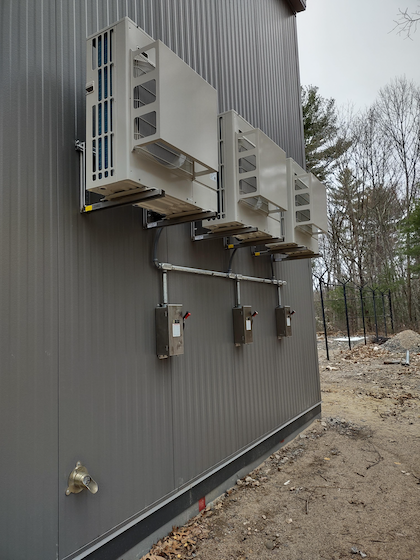
Three condensing units for an air-source heat pump system supporting all of the comfort heating and cooling loads for a wastewater treatment facility in Missouri.
In another example, a major corporation needed to replace an outdated heating system at a large office complex in Colorado. The existing system used 3 MMBtu per hour of steam for comfort heating and domestic hot water (serving potable water throughout and to a kitchen at the base of the building). The steam system was replaced by two 1.5 MMbtu per hour, condensing water boilers to serve the same loads for the building.
Heat pumps were not as well-known for commercial applications at the time of installation, so they were not considered, and this presented a missed opportunity. It is likely the comfort cooling and heating load, as well as the domestic hot water load, for the entire building could have been served by heat pumps. This approach would have improved the cooling efficiency from replacing the existing packaged rooftop units (COP = 2.3 to 3.5) and dramatically improved the heating efficiency by 200-500%. An alternative design approach could have enabled simultaneous cooling and heating for different loads, further enhancing building performance.
Over the next decade, there will be a rapid integration of heat pumps in cooling and heating applications. Commercial uses are already expanding, and industrial use will dramatically increase over the next decade. Heat pumps cannot serve every cooling and heating application for industrial and commercial sectors today, particularly industrial-scale processes requiring specialized equipment. However, there are still substantial opportunities to leverage these systems in industrial environments especially as the technology advances. When applicable, leveraging the benefits of heat pumps to provide heating and cooling in one system is an excellent way to reduce utility costs and carbon emissions.
About the Author
Philip Johnston is a Mechanical Engineer who partners with clients to optimize their industrial energy systems in service to their energy and sustainability goals. He has over a decade of experience developing viable energy and carbon strategies encompassing a wide range of processes, such as chilled water, refrigeration, steam, compressed air and process heating and cooling.
About E4E Solutions
E4E Solutions specializes in the development, design, engineering, implementation and financing of innovative energy efficiency and de-carbonization projects that deliver energy savings, reduce operating costs and modernize and renew utility system infrastructures. For more information, visit https://e4esolutions.com.
To read similar Cooling Technology articles, visit https://coolingbestpractices.com/technology.
Visit our Webinar Archives to listen to expert presentations on Cooling Technology at https://coolingbestpractices.com/magazine/webinars.
