
How A2L and R-290 Refrigerants Are Changing Glycol Chiller Design, Safety and Compliance
For decades, specifying a glycol chiller was primarily a thermal engineering exercise. You defined your process temperature, calculated your heat load, selected your refrigeration compressor technology and sized your heat exchangers. The refrigerant was almost an afterthought – choose R-404A or R-448A, load it and move on.
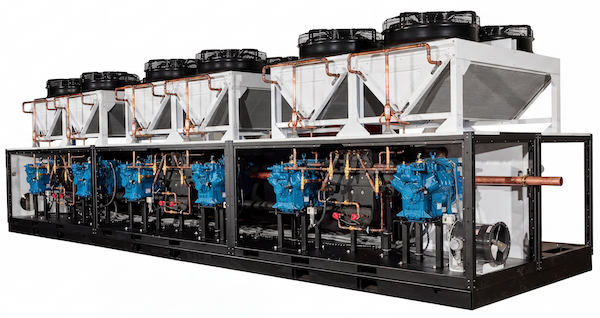
Now, there’s an entirely new process and a new set of standards guiding the process cooling industry. Three overlapping regulatory frameworks are as important to chiller design as the vapor-compression cycle itself:
- The EPA's AIM Act, which phases down high-GWP HFCs
- Updated ASHRAE Standards 15 and 34, which classify A2L refrigerants and define their safety requirements
- The 2024 ICC I-Codes, which have updated building and mechanical codes to permit A2L use with specific engineering controls in place
This is not a future problem. The EPA phase-down rules affecting industrial process cooling equipment took effect on January 1, 2026. If you are specifying new equipment or planning a replacement cycle, these standards are already in play.
We standardized our glycol chiller platform on A2L refrigerants – not because we had to, but because our customers need equipment that’s not only compliant today but also serviceable for the next 20 years. The decision required working through the engineering implications of these three frameworks at the same time. This article documents what we learned and, hopefully, sheds light on where the industry is headed.
.png)
Breaking Down the New Chiller Regulations for Engineers
Understanding the refrigerant transition requires working through these three regulatory frameworks simultaneously. Each governs a different aspect of the system. Compliance with one does not guarantee compliance with the others.
The EPA AIM Act: Refrigerants Permissible for New Equipment. The American Innovation and Manufacturing (AIM) Act authorizes the EPA to phase down the production and import of hydrofluorocarbons (HFCs). The mechanism is a tiered phase-down schedule reducing how much HFC refrigerant can be manufactured or imported into the U.S. over time, eventually capping production at 15% of the 2011-2013 baseline by the year 2036.
For industrial process cooling applications, the rule is specific. As of January 1, 2026, new chillers serving industrial process cooling systems with setpoints above -22°F (-30°C) must use refrigerants with a GWP of 700 or lower. This eliminates most of the legacy HFC blends that have dominated glycol chilling applications for the past three decades.
R-404A has a GWP of 3,922. Many R-448A blends fall around 1,390. Neither can be specified for new industrial process cooling equipment. This is not a grandfather clause situation for new equipment. If you’re buying a new glycol chiller today, it cannot be built with these refrigerants for industrial process cooling applications. Any glycol chiller specified today for an industrial process cooling application must use a refrigerant with a GWP at or below 700 – no transitional provisions apply to new equipment.
ASHRAE Standards 15 and 34: The Safety Architecture. ASHRAE 34 is the refrigerant safety classification standard. It uses a two-part designation: The first letter indicates toxicity (A for lower, B for higher), and the number indicates flammability (1 for non-flammable, 2L for mildly flammable with burning velocity at or below 10 cm/s, 2 for flammable, 3 for highly flammable).
A2L is the new critical category. These refrigerants have low toxicity and mild flammability – a burning velocity at or below 10 cm/s, compared to propane's 46 cm/s. They can be used in occupied commercial and industrial spaces with defined engineering controls. That distinction – that mild flammability does not require the same engineering response as high flammability – is what makes A2Ls practical for packaged commercial chillers.
ASHRAE 15 is the system safety standard. It defines refrigerant concentration limits (RCL) by occupancy category, ventilation requirements, leak detection specifications and machinery room design criteria. The RCL limits are a binding design constraint: They determine maximum permissible refrigerant charge, which in turn drives component selection, circuit architecture and piping design.
ICC 2024 I-Codes: Code Adoption and Permitting. The 2024 International Mechanical Code and International Fire Code formally permit A2L refrigerants with defined engineering requirements. This is a meaningful change: Earlier code editions were more restrictive about any refrigerant with a flammability classification.
However, there is a catch: State and municipal adoption of the 2024 I-Codes is uneven. Some jurisdictions are current; others still operate under 2018 or 2021 editions. Before specifying A2L equipment for a given project, engineers need to verify which code edition is in force for that jurisdiction and be prepared to work with the authority having jurisdiction (AHJ) on A2L system approvals where older editions still apply.
These three frameworks – EPA AIM Act, ASHRAE 15/34 and the ICC I-Codes – must be read together. Refrigerant selection, system safety engineering and installation code compliance all affect each other. Engineers who understand each framework independently and holistically will specify equipment correctly the first time – a critical step saving time and money down the road.
What A2L Means for Thermal Performance
One of the most common concerns I hear from engineers encountering A2L refrigerants for the first time is about performance and whether or not capacity will suffer. Will the system deliver the same cooling capacity? Will efficiency suffer?
The short answer to that last question is no. The vapor-compression cycle is the same. A2L refrigerants operate within familiar pressure and temperature ranges, with thermodynamic properties delivering efficiency comparable to – and in many cases modestly better than – the HFC refrigerants they replace.
Refrigerant GWP Comparison
| Refrigerant | GWP | Classification | Status |
|---|---|---|---|
| R-404A | 3,922 | A1 (non-flammable) | Eliminated for new industrial process cooling equipment |
| R-448A | ~1,390 | A1 (non-flammable) | Eliminated for new industrial process cooling equipment |
| R-454B (Opteon XL41) | ~466 | A2L (mildly flammable) | Compliant; used in HVAC and process cooling |
| R-32 | 675 | A2L (mildly flammable) | Compliant; higher-pressure applications |
| R-290 (propane) | 3 | A3 (flammable) | Ultra-low GWP; requires hazardous-location engineering |
The efficiency story for A2Ls in glycol chilling applications – 20°F to 50°F (-7°C to 10°C) leaving fluid temperature – is largely positive. At these temperature ranges, A2Ls maintain strong COP performance. The concern about degraded thermal performance has not materialized in practice.
What does change is the engineering required around the refrigerant's safety classification. A2Ls are mildly flammable. That property drives requirements around refrigerant charge limits, enclosure design, leak detection, ventilation and electrical component ratings. None of these requirements is prohibitive. But they must be designed in from the start; they cannot be field-retrofitted onto a conventional HFC chiller.
The distinction between A2L and A3 refrigerants matters here. R-290 (propane) carries a higher flammability classification than A2Ls and requires more rigorous hazardous-location engineering, including Class I, Division 2-rated fans and ducted enclosure ventilation. The trade-off is a GWP of approximately 3, essentially zero environmental impact from refrigerant leakage. The right refrigerant depends on the application, facility layout and local code adoption, but both A2L and R-290 pathways are viable for commercial glycol chilling.
Charge-Limit Engineering: Where the Real Work Lives
If there is one discipline most clearly differentiating A2L-compliant chiller design from conventional HFC design, it is refrigerant charge-limit engineering. This is where regulatory requirements translate directly into hardware decisions.
The governing framework is the ASHRAE 34 refrigerant concentration limit (RCL). For a given occupancy category, the RCL defines the maximum refrigerant concentration in the space in a worst-case total release scenario. For commercial and industrial process cooling applications, the RCL is a hard ceiling. Engineers must design to it, not around it.
The practical implication: A chiller cannot simply be recharged with a lower-GWP refrigerant and called compliant. The charge quantity itself must be appropriate for the installation environment. For larger packaged chillers in particular, this requires rethinking the system architecture from the ground up.
Four Engineering Levers for Charge Reduction
Heat Exchanger Selection. Brazed plate heat exchangers hold dramatically less refrigerant than shell-and-tube designs at equivalent capacity – in many cases 50 to 70% less. Switching from shell-and-tube to brazed plate evaporators is typically the single most impactful charge-reduction measure available. Microchannel coils offer similar advantages on the condenser side. The thermal performance of brazed plate exchangers in glycol chilling applications is excellent; the charge reduction benefit is essentially free.
Circuit Architecture. Dual-circuit and multi-circuit designs allow each refrigerant circuit to be sized – and charged – independently. The total system capacity is maintained, but each circuit's charge stays within RCL limits. There is an additional efficiency benefit: Multi-circuit systems improve part-load performance by staging refrigerant compressors to match actual load rather than running a single large refrigerant compressor at reduced efficiency. For applications with variable load profiles – wineries, food processing, data centers – this is a meaningful operational advantage.
Piping Discipline. Minimizing the length of liquid and suction lines, optimizing pipe diameters to reduce dead volume and routing refrigerant piping carefully are unglamorous but measurable contributions to charge reduction. This is detail work. On a large system, it adds up. Routing decisions made during initial layout lock in refrigerant charge requirements for the life of the equipment.
Liquid Receiver Minimization. The liquid receiver is often a significant source of refrigerant volume. Reducing or eliminating it requires tighter electronic expansion valve (EEV) tuning and more precise control logic, but enables meaningful charge reduction without sacrificing system stability. This approach demands more from the control system but pays dividends in system responsiveness and efficiency.
A Real Number to Illustrate the Scope
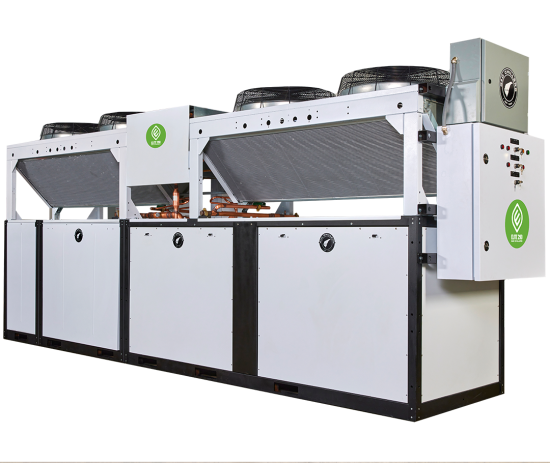
When we developed our Elite 290 series – our R-290 (propane) platform – the charge-reduction challenge was severe. Propane carries an A3 flammability classification, so charge requirements are more stringent than for A2Ls. Starting from a conventional dual-circuit design carrying approximately 95 pounds of refrigerant per circuit, we worked through each of these levers: brazed plate evaporators, optimized piping, EEV tuning and receiver minimization.
The final design landed at six pounds of propane per circuit – a 16-to-1 reduction – while delivering full rated capacity at the design setpoint. For context, that is less refrigerant by weight than a standard backyard barbecue cylinder contains.
The charge-reduction engineering developed for R-290 has carried directly into our A2L platform design. The principles are the same even if the thresholds are different. Reduced charge improves system response, tightens superheat control and reduces risk, outcomes that matter regardless of which refrigerant is in the system.
Safety Engineering: Four Elements to Consider in the Design Phase
A2L compliance is not a single checkbox. It is a set of integrated engineering requirements that must be built into the system design from the outset. These elements must be engineered in; retrofitting them in the field is not a viable path.
Integrated Leak Detection. Refrigerant sensors must be positioned at appropriate accumulation points based on the refrigerant's vapor density relative to air. For most A2Ls, which are heavier than air, sensors belong low in the equipment enclosure. Alarm thresholds are typically set at 10% of the lower flammability limit (LFL), a conservative margin providing substantial time between alarm and any flammability risk.
At alarm, the system should de-energize the chiller and activate ventilation. This logic must be integrated into the chiller's control system, not added externally, and it must be documented and verified during commissioning. A leak detection sensor mounted to the skid without integration into the control sequence does not satisfy ASHRAE 15 requirements.
Ventilation Strategy. ASHRAE 15 ventilation requirements are calculated from refrigerant charge, room volume and occupancy classification. For outdoor or semi-outdoor installations – which describe a large share of commercial and industrial process cooling – the natural ventilation of the installation environment typically satisfies ASHRAE 15 requirements. For indoor installations, mechanical ventilation sized to the RCL calculation is required.
Ventilation design must be coordinated between the chiller manufacturer and the installing engineer before the project reaches startup. It cannot be resolved at commissioning.
Electrical Component Ratings. Components inside A2L refrigerant enclosures must be rated for use in mildly flammable atmospheres. Updated UL and ETL standards now address A2L-compatible component certification. This means attention to spark suppression, motor winding insulation class and control panel wiring practices. For A3 systems (R-290), the requirement escalates to Class I, Division 1 ratings – a more involved specification with a smaller field of certified components.
Safety Interlock Documentation. A2L installations increasingly require AHJ review, particularly in jurisdictions still adopting updated I-Codes. The equipment's technical file must document the leak detection alarm logic, ventilation activation sequence, safe shutdown procedure and component certifications. Chiller manufacturers should provide this documentation as a standard deliverable. Engineers should request it during the submittal stage – not discover it’s missing during inspection.
The integration of these four elements is what distinguishes a chiller that’s technically A2L-compatible from one that’s genuinely A2L-compliant. They are not the same thing.
Validating Thermal Performance: What the Specifications Actually Mean
Understanding how to evaluate chiller performance data matters more as refrigerants change and new products enter the market. Rating standards describe a specific set of conditions that rarely match what happens in the field.
AHRI 550/590. Air-cooled glycol process chillers are rated under AHRI 550/590. These standards define entering and leaving fluid temperatures, ambient temperature and glycol concentration at the rating condition. Published capacity and efficiency data are valid at those conditions, and often nowhere else.
At ambient temperatures above 95°F (35°C), air-cooled chiller capacity can derate by 15 to 25% compared to published ratings, depending on condenser design and control strategy. For facilities in hot climates or with equipment located in warm enclosures, this derating is not academic. A chiller selected at AHRI-rated capacity may be undersized for peak summer demand in a hot climate.
The Correct Specification Inputs. Before evaluating submitted performance data, engineers should specify leaving fluid temperature (LFT) at design load, entering fluid temperature (EFT), design flow rate, glycol type and concentration and design ambient temperature. Then verify the manufacturer's submittal data reflects performance at those exact conditions, not AHRI standard conditions.
A chiller rated at 50 tons at 45°F (7°C) LFT may deliver only 38 tons at 28°F (-2°C) LFT under the same ambient conditions. LFT is the number that matters for your process, not the nameplate tonnage.
COP Versus IPLV. Coefficient of performance (COP) at full design load is the right metric for steady-load applications, such as dairy and food processing. Integrated part-load value (IPLV) is more informative for applications with variable loads, such as HVAC, where cooling demand tracks environmental and seasonal conditions. Multi-circuit chillers improve IPLV by staging refrigerant compressors rather than throttling a single large machine.
Our chillers ship after a factory run-test under load that validates capacity at specified conditions, confirms refrigerant circuit integrity, exercises safety interlock logic and verifies control setpoints. Engineers should request the factory test report as part of the submittal review. It’s the most direct confirmation the equipment will perform as specified.
Planning the Transition: A Practical Framework
The regulatory clock isn’t pausing. The HFC phase-down accelerates through 2036, and refrigerant pricing for legacy HFCs is already reflecting tightening supply. Operators who begin evaluating their chiller fleets will now have better options – and lower transition costs – than those who wait.
A few questions worth working through for any commercial or industrial process cooling fleet:
- What refrigerant does each chiller in your facility use, and what is its GWP? Which systems are above the 700 GWP threshold that now applies to new industrial process cooling equipment?
- When does each unit come up for replacement? Is there a planning window to align refrigerant compliance with normal equipment lifecycle decisions?
- What code edition is in force in your jurisdiction? The difference between the 2021 and 2024 ICC I-Code editions has material implications for A2L system permitting.
- Does your chiller manufacturer offer factory-tested A2L-compliant safety systems, long-term service infrastructure for the new refrigerant class and engineering support for applications where charge limits require system-level design decisions?
Different facilities will reach different answers on A2L versus R-290. But both paths are engineered, tested and available. The era of treating refrigerant as an afterthought is over. The era of treating it as an engineering discipline has begun.
Thermal performance standards for glycol chillers are no longer solely about heat-transfer efficiency. They are about refrigerant compliance, safety engineering, charge-limit architecture and installation code navigation, all of which now belong to the same design problem.
The engineers who understand ASHRAE 15 and 34, the AIM Act phase-down schedule and the 2024 I-Code framework today will specify equipment that performs, installs without permitting surprises and remains serviceable for the next 20 years. The refrigerant transition is not a disruption to standard chiller engineering practice; it’s the next chapter.
Waterbrook Winery/Precept Wine
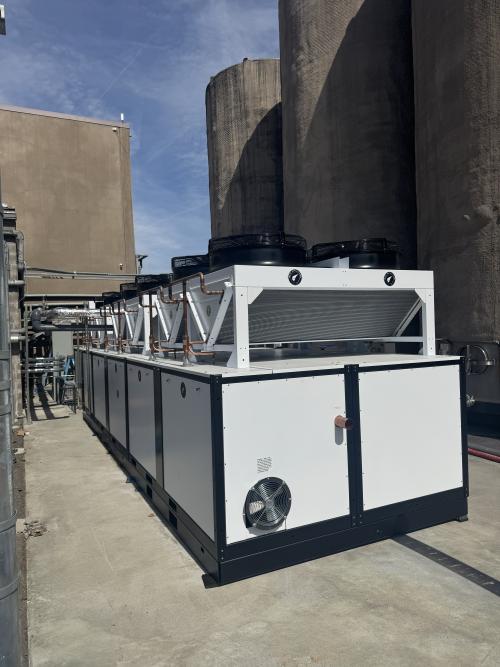
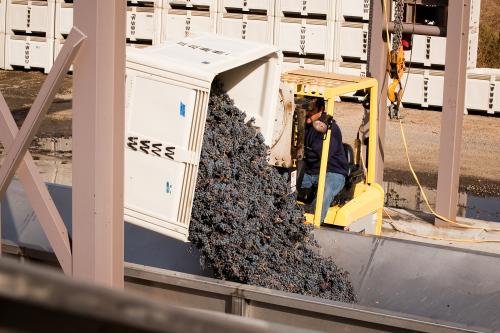
Waterbrook Winery, located just outside downtown Walla Walla, WA, has been one of the anchor estates of the Walla Walla Valley appellation since the early days of the region's emergence as a world-class wine area. Today, it operates as a flagship brand within Precept Wine, a Seattle-based company managing over 30 wine labels and a substantial production and distribution infrastructure across the Pacific Northwest. When Waterbrook's operations team began evaluating chiller options for their cooling system, the conversation moved past refrigerant type to refrigerant strategy quickly. Like many commercial operations in agriculture and food processing, Waterbrook was looking at a longer planning horizon than a single equipment cycle. The question was not only what would work today, but what would still be the right decision in 10 to 15 years. The answer was a chiller with a GWP of approximately 3, exceeding the EPA's 700 GWP threshold not by a margin, but by a factor. For Precept Wine, whose portfolio spans more than 30 labels and whose decisions propagate across a large production infrastructure, choosing equipment sitting well ahead of the regulatory curve matters for future-proofing its large-scale operations. For a winery, precise temperature control isn’t a preference – it’s a production requirement. Fermentation temperature management is one of the most consequential variables in wine quality. Glycol chilling systems that drift, cycle erratically or go down during peak fermentation season create quality and financial risk winemakers take seriously. The specified chiller delivers on both fronts. The winery’s unit achieved a 22-to-1 refrigerant charge reduction versus a conventional system and also produced tighter superheat control, more responsive load following and consistent capacity at the design setpoint. These qualities translate to fermentation temperature stability. From a compliance standpoint, the installation gives Waterbrook – and, by extension, Precept Wine's portfolio planning – a clear forward position. R-290 is a natural refrigerant predating the HFC era. Whatever the regulatory trajectory looks like over the next 20 years, this chiller isn’t at risk of becoming noncompliant. This installation is one of a growing number of food and beverage projects moving to ultra-low-GWP refrigerants ahead of regulatory requirements. The calculus is straightforward: The engineering investment to comply today is no greater than the engineering investment to comply in three years, and the equipment purchased today has a 15- to 20-year life. Getting that decision right matters. "We wanted a decision we wouldn't have to revisit in five years. The Elite 290 gave us that, and G&D made the whole process easy," said Mike Allen, Director of Facilities, Precept Wine.
|
About the Author

Paul Johnson is Director of Technology and R&D at G&D Chillers, where he has served as Chief Engineer since 2006, leading design, testing and continuous improvement across the company's industrial and process chiller platforms. Over two decades, he has driven the shift toward higher-efficiency refrigeration compressors, low-GWP refrigerant adoption and rigorous factory testing, now backed by the engineering resources of a global industrial technology leader. Paul is based at G&D's Junction City, OR, facility.
About G&D Chillers
G&D Chillers, an Ingersoll Rand business based in Junction City, OR, has standardized its glycol chilling platform on low-GWP A2L refrigerants – including R290 propane units – for commercial brewing, wine, dairy, food processing, manufacturing, biogas, data centers and commercial HVAC applications. Since 1993, the company has supported industry leaders including Ninkasi, New Belgium Brewing, Willamette Valley Vineyards, Jim Beam, Boeing and Diageo. For more information, visit https://gdchillers.com.
For similar articles on Chiller Technology, please visit https://coolingbestpractices.com/technology/chillers.
Visit our Webinar Archives to listen to expert presentations on Chiller Technology at https://coolingbestpractices.com/magazine/webinars.
