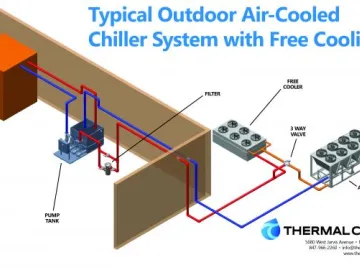
Free-Cooling
Free cooling is a type of process cooling system design that takes advantage of ambient temperatures to reduce or even eliminate chiller operation. Chillers consume large amounts of energy; so, reducing a chiller’s operating hours per year can result in significant bottom line savings for your company. In this article, we will review a typical free cooling system design, some of the considerations for your system, and finally, how these considerations impact your system’s ability to capitalize on the free cooling operation.
The initial reason the modular concept took hold was a frequent lack of space when it came time to replace a large chiller. Often, these chillers were installed in a confined mechanical room in the basement at the beginning of construction, and the building was then built around it. There was barely enough room to get people to the chiller for maintenance, let alone replacing the chiller itself.
[ Read Full Story ]
This article will explore the Cooling Technologies Institute (CTI) Standard 201 (STD-201) Thermal Certification This article will explore the Cooling Technology Institute (CTI) Standard 201 (STD-201) Thermal Certification Program, share perspective from leading cooling tower manufacturers, and cover other existing and evolving CTI test codes, standards and certifications. This article will also emphasize the investment and bandwidth contributed to CTI by cooling tower manufacturers for the benefit of the industry and its end users.
[ Read Full Story ]
An Illinois food service products manufacturer now saves nearly 60% of their base annual cooling energy costs through improvements made in three phases over several years. The plant, which has a 1200 ton chilled water plant, implemented upgrades including pump and tower fan VFDs and enhanced function controls, free cooling, and chiller compressor drive retrofits. The revisions built through successive phases to capture further benefits from more complete utilization of the preceding steps’ capabilities.
[ Read Full Story ]
Schoeneck Containers, Inc. (SCI) is a company that thinks a lot about its future – and how to continue to maintain a long track record of profitability and reliability while meeting a growing demand for its quality plastic containers for customers throughout North America. It’s the kind of thinking driving the decision to install a closed-loop adiabatic fluid cooler and central chiller with free-cooling capabilities at the company’s new 250,000-square-foot production facility in Delavan, Wisconsin.
[ Read Full Story ]
“Evaporative cooling capacity for the district system is provided by a six-cell, open-loop cooling tower capable of 6,000 tons,” said Reid Olsen, USU Central Energy Plant Manager, who has been at the university for 26 years. “This tower serves the condensers of the water-cooled chillers at the heart of the district cooling system. There are four chillers in all, two of which are rated for 1,800 tons each, and the other two are 900 tons apiece. The cooling towers reject heat from the condenser water loop via evaporative cooling, allowing the chillers to supply chilled water to the campus cooling loop.”
[ Read Full Story ]
An airside economizer is typically used on a packaged rooftop or tied to an indoor AHU, allowing filtered outside air into the space when outdoor temperatures drop below 55°F (12 °C) (the common supply air temperature of indoor spaces) thus alleviating the need for the refrigeration cycle to be running. Interior space is being cooled yet the refrigeration system is not running, hence the name Free Cooling.
[ Read Full Story ]
Process cooling system applications experiencing constant production loads generating high process fluid temperatures are particularly good candidates to take advantage of low ambient temperatures. Low ambient temperatures can be used as a “free” energy source, replacing the electricity required to run refrigeration compressors, in what is known as a free-cooling chiller system.
[ Read Full Story ]
Heat recovery opportunities have resulted in the largest amount of savings of our common projects our industrial energy management teams have implemented. It is not the easiest type of project to implement but the amount of savings and the reduction of emissions makes this project very worthwhile.
[ Read Full Story ]