Corporate Sustainability Programs

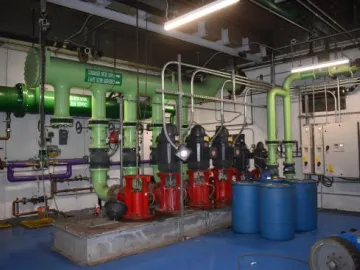
Johnson Controls’ most recent decarbonization project has gone right to the heart of its 2040 net-zero commitment – working with its own Norman, Oklahoma, manufacturing facility on a chilled water plant and compressed air system upgrade that is projected to nearly halve its greenhouse gas emissions.

As the Best Practices Magazines celebrate their twentieth anniversary, we wanted to take a moment to reflect on the remarkable system efficiency gains achieved since our first issue. We also wanted to give subscribers a peek at what the next decades might bring. To do this, we asked a hand-selected list of original equipment manufacturers, independent compressed air system sales and service companies, manufacturing plants and independent system auditors to share their thoughts, highlighting the changes they’ve seen over the past 20 years, then predicting what the next 20 years will bring.
If we're using sustainability as a broader term, there's waste management, water, carbon, renewable power and more. Those are some of the units now part of the equation we're solving for. It sometimes ends up with a different set of solutions than you would typically end up with if you were only looking at dollars.
In February 2021, Chiller & Cooling Best Practices Magazine interviewed members of the Intertape Polymer Group Inc. (IPG) Sustainability Pillars team to gain an understanding of the work being done to improve energy efficiency. The team members interviewed were Michael Jones (Director of Corporate Energy), Michael Deitering (Senior Project Engineer), Jarrod Knapp (Maintenance Manager) and Mark Secord (Engineering Group Leader).
Among key initiatives at DENSO’s Maryville, Tennessee, facility is the use of an innovative ice-storage system engineered to provide environmentally friendly comfort cooling to employees at the company’s main production facility. The system also allows Plant 101 to reduce cooling costs per ton by 44%, while providing a payback of less than four years. It also resulted in an annual carbon dioxide (CO2) reduction of 18,000 tons.
Chrysler’s Technology Center (CTC), located in Auburn Hills, MI, is home to some fourteen thousand employees responsible for keeping the automotive giant in motion. Completed in 1991, the complex is essentially a small city, encompassing 5.3 million square feet situated on over 500 acres. In addition to corporate offices, the facility houses a full laboratory level of various wind tunnels with thermal testing capabilities, a 1.8-mile evaluation road, a noise/vibration facility, an electromagnetic compatibility center, an environmental test center (able to create rain, snow and extreme temperatures), and a pilot production plant.
Chiller & Cooling Best Practices interviewed Michael Jones, Corporate Energy Team Leader, from Intertape Polymer Group (IPG).   Intertape Polymer Group (IPG) is a manufacturer of tapes, films, woven fabrics, and complementary packaging systems for industrial and consumer use. The company operates 10 production plants and employs approximately 1,800 people. IPG has developed a robust energy management program by using ENERGY STAR energy management tools and actively participating in the ENERGY STAR partnership. IPG is receiving ENERGY STAR recognition for the growth of its energy program and leadership as a medium-sized manufacturer.
This is our first time receiving the award. We were hopeful we would receive it because we thought we achieved 23 out of the 23 attributes defined by the guidelines. Additionally, since the program was launched, GEM’s management practices have saved Corning more than $328 million in cumulative energy costs.  
You may be wise to watching the demand meter or shifting heavy loads to off-peak hours, but those are not your only options. With advanced energy management technology, you can automate control of energy from refrigeration compressors, pumps, and other equipment so that your facility runs at optimal efficiency, you pay the lowest possible rates, and you can participate in incentive programs that pay you for unused kilowatts.
There are three main segments in Visteon's climate group are climate systems, powertrain cooling and engine induction. Climate systems include refrigeration compressors, fluid transport, heat exchangers, battery cooling modules, climate controls, auto defog/demist systems, and multi-zone HVAC systems. Powertrain cooling systems include heat exchangers (radiators, condensers, charge-air, exhaust-gas), airflow management, and diesel and hybrid thermal management. Engine induction includes air induction systems and intake manifolds.
This paper presents a discussion on the topic of Electric Demand Management as it relates to electric tariff rates, new power generation, and incentives to curtail peak usage.