Dry Coolers

Adiabatic coolers are rapidly gaining ground in plastics processing as manufacturers seek sustainable, energy-efficient alternatives to traditional cooling towers. By operating in dry, adiabatic and free-cooling modes, modern systems engineered by Frigel North America deliver up to 90% water savings, lower energy consumption and improved temperature stability for injection molding, PET, extrusion and thermoforming applications. With reduced maintenance, closed-loop protection and long-term ROI advantages, adiabatic cooling is emerging as the new benchmark for high-performance industrial process cooling.

Water-Saving Dry Cooling Technologies for Industrial Applications

This article explores how air-cooled heat rejection systems are reshaping industrial cooling strategies as water conservation becomes a growing priority. By breaking down performance trade-offs, system configurations, and real-world sizing comparisons, it highlights when and where these technologies make the most sense. Engineers and facility managers will gain practical insights to evaluate cooling options, balance efficiency with sustainability, and make smarter long-term infrastructure decisions.

The 2026 Cooling Technology Institute Annual Conference

This article shares updates to CTI standards and acceptance test codes, synopsizes the event’s educational curriculum, shares perspectives and highlights firms attending this year’s annual conference for manufacturers, owner-operators and suppliers of heat rejection equipment.

Best Practices 2025 EXPO & Conference Chiller & Cooling Show Report

The event gathered a record number of cooling system providers exhibit, a fact appreciated by the many cooling reps in attendance. “It’s been beneficial,” said Spencer Kaufman, Sales Engineer, Midwest Machinery. “There are decision-makers and people here who do a lot of design work, not only in our market but all across the country. The conversations we’ve been having have been very deep – often up to 15 minutes. The quality of the conversations has been really good.”  

How Adiabatic Technology Delivers Performance, Savings and Sustainability

As facility managers, industrial engineers and procurement professionals strive to meet rising demands for energy efficiency, water conservation and sustainability, cooling systems have taken center stage. Among the various technologies reshaping the industrial and commercial cooling landscape, adiabatic cooling stands out as a compelling alternative to traditional methods. This article explores the evolving role of adiabatic cooling, its technical advantages and why it's gaining traction across industries.

Fluid Equipment Solutions Saves Energy and Water with Dry, Hybrid and Adiabatic Cooling

The selection criteria for the hybrid fluid cooler considered year-round temperatures. Summer duty had an entering water temperature of 95°F (35°C) and a leaving water temperature of 85°F (29°C). In winter, the wireless provider could use the fluid cooler for direct free cooling, meaning it could send water directly through the fluid cooler, bypassing the chiller. Entering water temperature was 55°F (13°C) and leaving water temperature was 44°F (7°C).

EVAPCO’s Journey to Dry and Hybrid Cooling Technologies

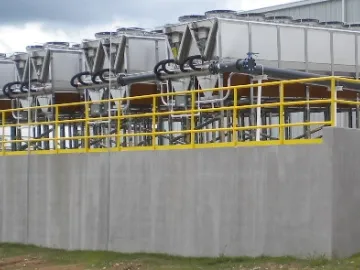
Dry fluid coolers use ambient air to reject heat from hot process fluids running through the unit’s closed-circuit coil heat exchanger. Dry coolers have either flat or V-shaped configurations. Hybrid fluid coolers combine closed-loop dry cooling with evaporative cooling for an efficient design that uses less water. Hybrids can be run in dry mode when the temperature set point can be met by dry cooling alone. Adiabatic coolers are a type of dry cooler that use some water to pre-cool the ambient air used to reject heat from the process fluid. 

Hoffman & Hoffman Grows by Following Their Customers, Staying Flexible

In Spring 2024, Chiller & Cooling Best Practices Magazine interviewed Chuck Honeycutt and Brad Davis from Hoffman & Hoffman to discuss best practices in chiller and cooling tower sales and system design. This article will explore how the company has expanded into new areas during its 75-year history. It will also explore a large cooling tower installation at a Colorado biotech. 

The 2024 Cooling Technology Institute Annual Conference

The 2024 Cooling Technology Institute (CTI) Annual Conference for manufacturers, owner-operators, and suppliers of heat rejection equipment (i.e., cooling towers, adiabatic coolers and dry coolers) was held Feb. 4 – 8 at the Westin Galleria in Houston, TX. This article will share some updates to CTI standards and acceptance test codes, synopsize the event’s educational curriculum, share perspective, and highlight products and services offered by a sampling of firms at the event’s trade show. 

CTI Standard 201: Certifying Thermal Performance of Heat Rejection Equipment

This article will explore the Cooling Technologies Institute (CTI) Standard 201 (STD-201) Thermal Certification This article will explore the Cooling Technology Institute (CTI) Standard 201 (STD-201) Thermal Certification Program, share perspective from leading cooling tower manufacturers, and cover other existing and evolving CTI test codes, standards and certifications. This article will also emphasize the investment and bandwidth contributed to CTI by cooling tower manufacturers for the benefit of the industry and its end users. 

Waterside Economizer for Air-Cooled Chillers

This article discusses using devices known as “waterside economizers” and “dry coolers” as means to achieve “free-cooling”. Free cooling (sometimes referred to as a “free cooling system”) can reduce energy consumption and operating costs by using cold ambient air in lieu of running chiller compressors for cooling loads.

Refrigeration Energy Efficiency Audit at a Myanmar Fish Processing Plant

This article contains pieces from an audit report developed for a fish processing plant located in Yangon, Myanmar. It is located in the Thinbawgin Ward of Dawbon Township in Yangon, Myanmar.  The objective is to show factories the information they may want to have gathered on their refrigeration systems and supporting cooling systems.

Evaporative Cooling for Chillers and Dry Coolers

Physics teaches us that water, when evaporating in an adiabatic system, removes sensible heat from such system. The temperature thus decreases. In order for the water to evaporate, energy is required, specifically 2501 kilojoules for each kilogram of evaporated water. In the absence of an external energy source, the water absorbs the required energy from the environment, in this case from the surrounding air. As a consequence, the air is cooled. In simple terms, it can be stated that evaporation of water converts the sensible heat of the air (temperature) into latent heat (humidity). As a result, the system is cooled and humidified at the same time. This type of cooling is referred to in literature as evaporative cooling or adiabatic cooling.

Savings at the Steel Mill

This major mill complex upgraded their compressed air system and thereby eliminated $500,000 in annual rental compressor costs, reduced annual cooling-water costs by $500,000, and reduced electrical energy costs by $135,000 per year.

Evaluating Air Compressor Cooling Systems

As the population continues to grow in the United States, industrial water use will need to continue to fall to help offset the increases in public-supply water use. Water-cooled compressed air systems provide an opportunity for sustainability managers to reduce associated cooling water consumption and costs. If switching to air-cooled air compressors is not possible, understanding the costs and the alternative types of liquid cooling systems is important.

Specifying an Air Compressor Cooling System

There are several pieces of information that your cooling system specialist will need in order to properly engineer and build a cooling system for your new air compressor. There are many types of air compressors and each has different requirements of the cooling system in order to operate correctly. This article will take the mystery out of some of the terms and specifications for your cooling system.

The Six Basic Types of Liquid Cooling Systems

There are six basic types of cooling systems that you can choose from to meet the cooling needs of your load. Each one has its strengths and weaknesses. This article was written to identify the different types of cooling systems and identify their strengths and weaknesses so that you can make an informed choice based on your needs.

Calculating the Water Costs of Water-Cooled Air Compressors

Compressed air systems are present in almost all industrial processes and facilities. They have been correctly identified as an area of opportunity to reduce electrical (kW) energy costs through measures like reducing compressed air leaks and identifying artificial demand and inappropriate uses. Water-cooled air compressors can also be significant consumers of water and reducing these costs can represent a second area of opportunity.

Upgraded Cooling System at Paper Mill

This article reviews two major processes in paper mills: compressed air quality and air compressor cooling.  The central air compressor room was expanded and relocated at the largest privately owned paper mill in Canada.  The compressor space was required by a plant expansion, which would occupy the original compressor space for increased production.

Heat-Reclaim Economics of Air and Water-Cooled Air Compressors

It is widely recognized that compressed air systems account for ten percent of all electricity and roughly sixteen percent of U.S. industrial motor system energy use. Seventy percent of all manufacturing facilities in the United States use compressed air to drive a variety of process equipment.