Food

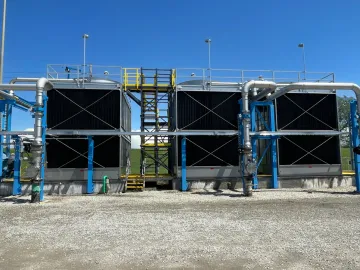
Bayer Crop Science runs a 240-acre fertilizer production facility with areas for active ingredient and chemical intermediate production, as well as a high-active herbicide production unit. Among the multiple cooling towers at the facility was a 40-year-old field-erected, three-cell, wooden, crossflow Marley cooling tower used for rejecting heat and providing cooling for multiple processes. 

Refrigerant Regulations Reshape Chiller Thermal Performance Engineering

The transition to low-GWP refrigerants is changing glycol chiller design, safety and compliance requirements. This article examines how A2L and R-290 refrigerants affect refrigerant charge, system architecture, leak detection, ventilation and performance validation, while highlighting key considerations under EPA, ASHRAE and ICC requirements.

Twenty Years of Case Studies: Plants Sharing Best Practices

For 20 years, Chiller & Cooling Best Practices Magazine has published articles focused on helping manufacturers reduce power demand, lower water consumption, and improve the performance of compressed air, cooling, blower and industrial vacuum systems. In this article, we highlight a sampling of those stories across the following industries: Plastics and Packaging Food and Beverage Automotive and Transportation Cement, Building Materials, and Mining Metals, Pulp, and Paper Pharmaceuticals, Healthcare, and Research Wastewater Treatment

New Belgium Brewing’s Path to Low-GWP Refrigeration

This article examines how a natural refrigerant–based chiller was engineered to meet process cooling demands while minimizing environmental impact. It explores refrigerant selection tradeoffs, system architecture modifications required for flammable refrigerants and key design strategies such as charge reduction, mechanical isolation and safety controls. Engineers will gain practical insight into balancing efficiency, compliance and operational reliability in next-generation cooling systems.

Process Cooling Systems Engineers for Industrial Applications

In this article: Cooling for High-Speed Injection Plastic Molding Free Cooling Results in Massive Energy Savings Heat Treating Processes Require Cooling to Prevent Furnace Overheating Food Processing Cooling Needs Vary by the Specific Process Chemical Plants Need Ultra-Cold Conditions

Cooling System Energy Savings in Three “Easy” Steps

An Illinois food service products manufacturer now saves nearly 60% of their base annual cooling energy costs through improvements made in three phases over several years. The plant, which has a 1200 ton chilled water plant, implemented upgrades including pump and tower fan VFDs and enhanced function controls, free cooling, and chiller compressor drive retrofits. The revisions built through successive phases to capture further benefits from more complete utilization of the preceding steps’ capabilities.

Show Report: The 2022 IPPE

The 2022 International Production & Processing Expo (IPPE), was held January 25-27, 2022 in Atlanta with more than 500,000 square feet of exhibit space and 1,140-plus exhibitors. Attendee numbers had not been released when this was written. Sponsored by the U.S. Poultry & Egg Association, American Feed Industry Association and the North American Meat Institute, IPPE is the world's largest annual poultry, meat and animal food industry event of its kind. 

Bayer Crop Science Chiller Replacement Project

In 2010, an 800-ton water-cooled chiller was installed at the SFP plant to provide process chilled water to support the active diffusion process in the plant.  The 800-ton chiller was connected to a common header with a 600-ton and a 1,000-ton chiller in a closed-loop system supporting the production process.  The chillers run year-round to create a constant 40°F water temperature for production equipment in the plant.

Sustainable Chilled Water Systems in Pharmaceutical Plants

Chiller & Cooling Best Practices Magazine spoke with Tom Pagliuco, Executive Director Global Energy Engineering at AbbVie, Inc. about best practices for optimizing chilled water systems in today’s pharmaceutical operations. 

Taking Heat From the Baking Industry

Industrial automation and process applications requiring a chiller or heat exchanger can come in all types of shapes and sizes, and cooling capacity demands can range from a few hundred Btu/hr. for bench top lab equipment to many million Btu/hr. for laser applications. Chiller sizing for large-scale end users such as beverage, chemical or plastics manufacturing usually will demand central systems to achieve the massive cooling capacity requirements compared with small- to medium-range point of use automation applications. These unique differences become more challenging for original equipment manufacturers (OEMs) as machine designers must anticipate a wide range of end-user operating environments and operator skill levels when specifying chillers or heat exchangers in contrast to end-user facilities where cooling capacity requirements are location specific and operator skill levels are known.  

ComEd® Incentivizes Chiller & Process Cooling Efficiency

The ComEd® Energy Efficiency Program offers incentives to help facilities save money by improving the efficiency of their equipment. Industries can receive standard cash incentives for common energy efficiency improvements or custom cash incentives for making improvements not included in the standard program.

Refrigeration Energy Efficiency Audit at a Myanmar Fish Processing Plant

This article contains pieces from an audit report developed for a fish processing plant located in Yangon, Myanmar. It is located in the Thinbawgin Ward of Dawbon Township in Yangon, Myanmar.  The objective is to show factories the information they may want to have gathered on their refrigeration systems and supporting cooling systems.

Free-Cooling Motivair Screw Chiller Cools a Craft Brewer

It’s no secret the craft beer market has grown dramatically in North America.  Local breweries and brewpubs are popping up across all regions of the United States as consumers seek unique, flavor-rich brews.  In fact, according to the Brewers Association, the trade association representing small and independent American craft brewers, in 2015 the number of operating breweries in the U.S. grew 15 percent, totaling 4,269 breweries – the most at any time in American history.  With more breweries than ever before, small and independent craft brewers now represent 12 percent market share of the overall beer industry.

Nestlé Beats the Heat: Innovative Air-to-Water Heat Exchanger Recovers Heat from Air-Cooled Compressors

When the topic of discussion is making ice cream, the first thing that comes to mind isn’t heat, but at Nestlé’s Ice Cream factory in Tulare, California, heat is recovered from air-cooled air compressors to heat process water. “Right out of the gate, everything is pneumatic,” explains Tom Finn, Project Engineer with Nestlé Ice Cream Division. “Air cylinders and air driven motors, the process piping valves which divert, route, stop/start, and mix process fluids, our packaging machinery including rejection, cleaning and vapor removal processes, all of these rely on compressed air.

Chillers Provide Temperature Regulation For Fine Wine

Temperature control of the musts during the fermentation process is required for the production of high quality wines. Alcoholic fermentation is the chemical reaction in which yeast is used to transform the natural sugars of the fruit into alcohol. The heat generated by this exothermic reaction has to be managed. If must temperatures are allowed to reach the 85°F to 105°F range the reaction will be stopped. This results in high sugar content and an unstable product that requires the addition of sulphur dioxide (SO2) to allow it to be stored without spoiling. In general, optimal fermentation temperatures are 65°F - 68°F for white wines and 77°F for red wines.