
Midwest Machinery, a rep firm based in St. Louis, MO, was the first manufacturer’s representative for Marley cooling towers beginning in 1923 (see sidebar), with a territory covering Eastern Missouri and Southern Illinois. In 2011, it became the Marley rep for Kansas and Western Missouri, as well, which is when it began working with Bayer Crop Science in Kansas City, MO.
Bayer Crop Science runs a 240-acre fertilizer production facility with areas for active ingredient and chemical intermediate production, as well as a high-active herbicide production unit. Among the multiple cooling towers at the facility was a 40-year-old field-erected, three-cell, wooden, crossflow Marley cooling tower used for rejecting heat and providing cooling for multiple processes. Bayer occasionally called upon Midwest Machinery to inspect and service the aging cooling tower.
The cooling tower’s condition worsened over time, and by 2022, Bayer Crop Science decided replacing the cooling tower made better financial sense than repairing it. That’s when Bayer contacted Midwest Machinery to see if it would like to bid on providing the materials for the replacement tower.
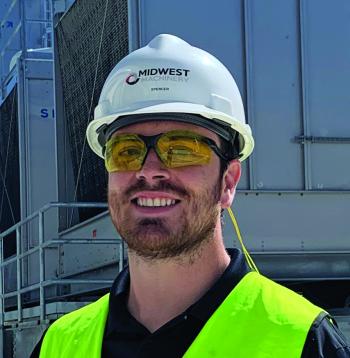
For Spencer Kaufman, Sales Engineer, Midwest Machinery, this became his favorite project at the company. It wasn’t the biggest project he worked on, but it held a variety of unique challenges.
Old Requirements, New Materials
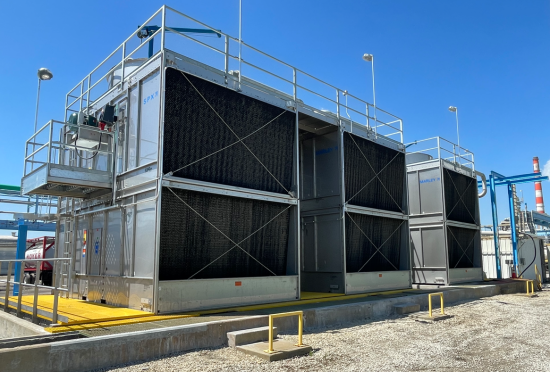
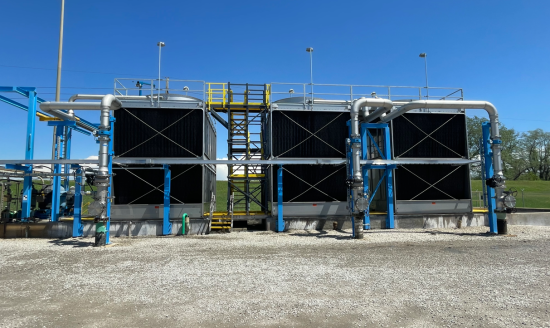
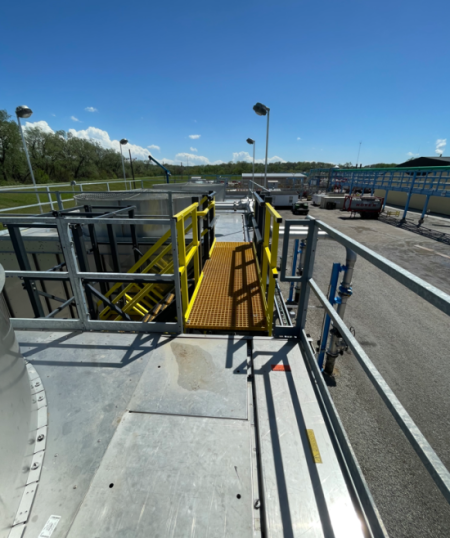
Midwest Machinery would help design the spec and provide engineering advice for the replacement, a three-cell, double-stack, dual air inlet, crossflow, factory-assembled Marley cooling tower capable of 2,625 gpm per cell, for a total 7,875 gpm. The tower is able to expel 3,937 tons with a hot water temperature of 100°F (38°C) and a return temperature of 85°F (29°C). The tower is entirely stainless steel. It includes a motor-mounted outside airstream with a motor services platform, internal mechanical access platforms, fan deck davits, air inlet screens, a free-standing fiberglass stairway and fan deck catwalks. The full tower is 23-feet wide, 60-feet long and 24-feet tall.
Kaufman took several calls with Bayer during the discovery phase to fully understand the company’s technical requirements. He reviewed the early specification and offered feedback so the company would get responses from bidders it could easily compare.
Because the original cooling tower had been supplied by a Marley rep, Midwest Machinery was able to access it and view the requirements. Bayer Crop Science was satisfied with the cooling tower’s performance duty, and didn’t request any changes in temperature, process flows or horsepower (hp). The design wet bulb temperature stayed the same at 77°F (25°C). The new cooling tower, like the old, needed to provide round-the-clock performance.
Crossflow towers are easier to maintain, Kaufman said, providing easier access. They provide more favorable water distribution, and their gravity-fed distribution is easier to maintain than a counterflow’s pressurized distribution. For these reasons, he prefers working with crossflow cooling towers in most applications. This cooling tower kept the same footprint and electrical infrastructure as the original, as Bayer declined to make any changes.
Replacement discussions started in April 2022, and Midwest Machinery submitted its bid in November 2022. At least two other companies made bids, Kaufman believes. While he doesn’t think his company was the low bidder, it was the one selected. Bayer saw the value Midwest Machinery’s cooling tower experience could bring.
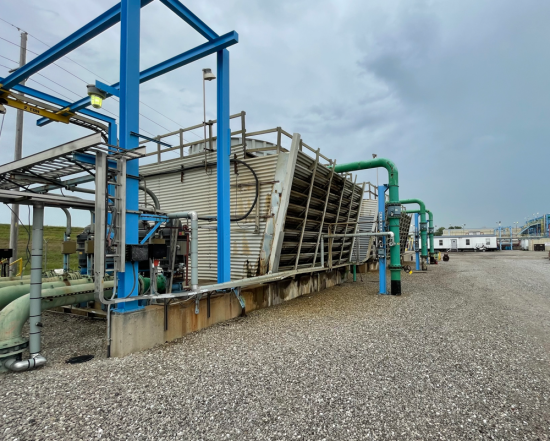
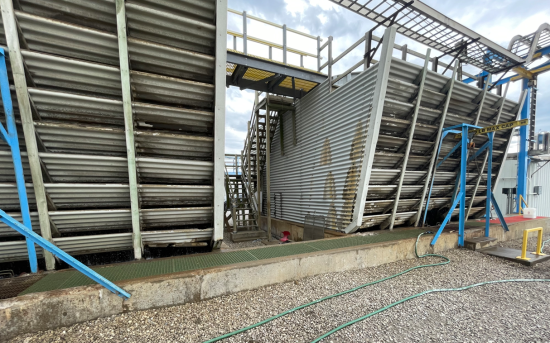
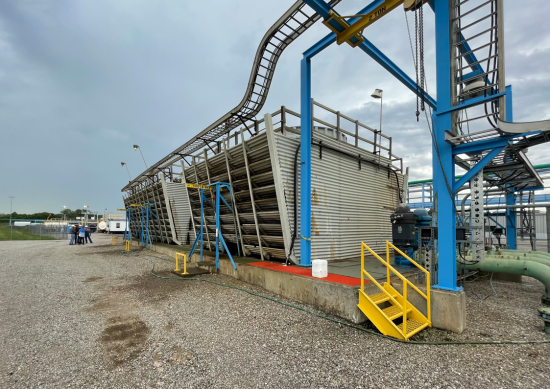
Moving Ahead Before the Design Is Complete
Midwest Machinery was awarded the project, and then the real work began. Bayer Crop Science had requirements making the installation an unusual challenge. The new cooling tower had to be erected on the exact foundation poured for the old cooling tower. No new concrete could be poured. There was a railroad nearby, and any project moving dirt needed an easement from the Army Corps of Engineers. While getting an easement was possible, doing so would cost the project time and money. Bayer wanted the project completed over the winter, when it could shut down one or two cooling cells without impacting its processes. Also, Bayer needed to spend the money on this project during a set budget window.
As this cooling tower was planned and built during the later Covid years, slow supply chains made it important to get parts ordered early, by July 2023. The fast schedule meant the initial request went in before the installation's design was fully completed. In a typical project, the design is solidified first, the equipment ordered and small problems inevitably arise needing to be fixed. With the inverted schedule, larger problems cropped up for Kaufman and Bayer’s engineering team to solve. Citing safety concerns, Bayer requested additional grading and access paths to keep technicians safe. Bayer also requested changes to make future maintenance easy, such as putting davits on the fan deck in case of a motor failure. Doing so makes removing the motor easier for future technicians. Because of the late additions, Kaufman had to put in multiple change orders to add or change equipment. The tower shipped in October 2023. Kaufman credits the in-house Bayer engineering team with coordinating all the details.
“I was concerned things weren't going to fit or the orientation would be off, just because it was all going in a different process than normal, but we worked diligently with the Bayer engineers to ensure it all worked out,” Kaufman said.
Adding All the Bells and Whistles
For Bayer Crop Science, safety and longevity were paramount in creating the cooling tower. Kaufman is used to offering clients tiers of options for maintenance features – a good, better, best selection. For this project, Bayer always chose the best tier. The fiberglass stair tower between two of the cells is an expensive selection, Kaufman noted. A more economical option would have been adding a ladder with a safety cage around it. But Bayer said no, it didn’t want its technicians to have to climb up ladders, as it was a safety issue for the company.
Likewise, when it came time for material selection, Bayer Crop Science went with an all-stainless steel construction, rather than an all-galvanized cooling tower, or one part-stainless and part-galvanized. An all-stainless construction offers better longevity, and Bayer wanted this tower to last.
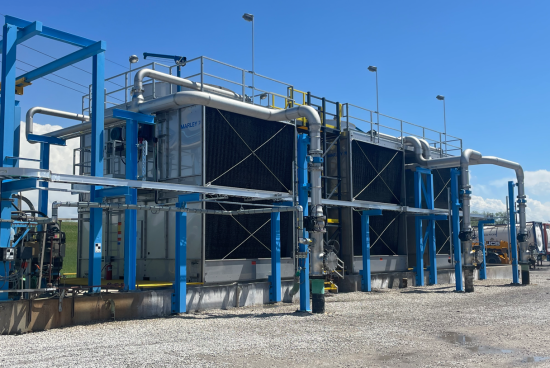
Adjustments and Additions During Construction
Once construction began, new challenges emerged. The original concrete basin had been poured 40 years prior. Getting the tower built required on-the-spot fine-tuning.
“Until you get in there and do inspections when the tower isn’t operating, you don't really know what you're dealing with,” Kaufman said. “We were changing how we were going to set the towers, what the anchorage would look like. We were changing elevations of the towers so we could get other components to set right, like the piping or the fiberglass stair tower.”
Local mechanical contractor Cerris Systems handled the cooling tower demolition and construction. Having Cerris Systems involved was a critical part of the operation, Kaufman said, as the company’s history with cooling towers made the installation seamless.
A Boost in Energy Efficiency
The older cooling tower had a variable frequency drive (VFD) that wasn’t part of its original construction. The new cooling tower, likewise, has a VFD. During partial load conditions or when the weather is cooler, Bayer can use the VFD to reduce fan speed and save money.
Besides helping with the project specification and design, Midwest Machinery offered Bayer Crop Science’s operations team advice on the best way to run its cooling tower. The optimal way is running all three cells, Kaufman says, and ramping all three up or down together with the VFD. That delivers the greatest energy efficiency. If Bayer has only one-third of the load, for example, it’s more energy efficient to run all three fans at 33% rather than shutting off two and running the third at full capacity.
While gaining efficiency wasn’t the driving force behind this installation, Kaufman notes Bayer Crop Science’s new cooling tower is more energy efficient. It has more cooling capacity than the previous, even though it has the same footprint and hp rating.
“It’s a more efficient cooling tower, and you combine that with using VFDs so they don't have to run the towers as hard in the wintertime. They’re doing it in about as efficient a manner as they can with the footprint they have allowed,” Kaufman said. “There was an increase in efficiency, probably in the 5-10% range.”
The challenge this cooling tower offered, the opportunity to work with an unusual process and getting to add a full slate of bells and whistles combined to make this Kaufman’s favorite project. The results – as shown in the pictures here – speak for themselves.
“It was a good challenge, but it was also extremely rewarding,” Kaufman said.
Midwest Machinery, Since 1923
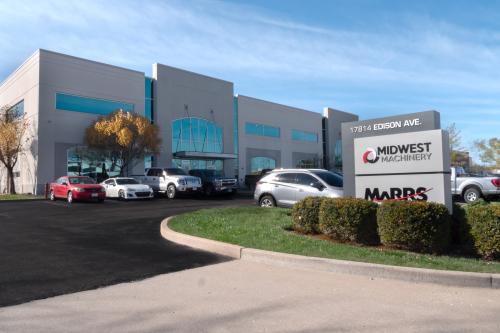
Headquartered in St. Louis, MO, Midwest Machinery has four offices covering territory from Illinois to Oklahoma and a bit of Texas and Arkansas. The company represents Marley cooling towers and many other well-respected manufacturers. Formed in 1923 by Leon T. Mart, Bernard G. Proetz and Merit Stone, it became the first Marley rep soon after (Mart had co-founded what would become the Marley Cooling Tower Company with Chester Smiley the previous year). The Gladstone family purchased Midwest Machinery in the 1980s. Troy Gladstone, President, is the second generation of Gladstones to run the company. “Being the first Marley rep, we bleed Marley blue,” said Ryan Miller, General Manager, Midwest Machinery. “It's close to our hearts. Here in Kansas City, more than half of our staff at one point worked under the Marley roof. We know the people, we know the inner workings of the company and we've got a lot of close personal relationships there. For us as an organization and as individuals, there's a close emotional tie to Marley. “Beyond that, Marley's always had a reputation as a high-quality manufacturer. It's a rigid, solid industrial product with lots of hours of engineering and testing behind it. Marley owns the design of the entirety of its products. It may outsource some of the manufacturing, but it owns the gearbox designs, it owns the fan designs and it pours a ton of money into research and development to optimize products and invent new ones. “Marley is always coming out with new products. It's great to be able to boast we represent the number one cooling tower manufacturer – both by size and reputation – in the world. “Some cooling tower manufacturers specialize in one particular type of tower, but Marley manufactures all types. No matter how you want to slice and dice the evaporative cooling category, whether you're talking field-erected or factory-assembled towers, counterflow or crossflow, open-cooling towers or closed fluid coolers, Marley does it all. “As a rep, it allows us to be 100% consultative to anybody in the market, whether we're talking to engineers about how a tower's going to fit into their particular application or contractors who are going to have to install it. No matter what we're talking about, we have an entire tool belt of all the things that might work for the application. Instead of trying to put a round peg in a square hole, we can ask the questions, find out all the needs of the project and then have the right product to go into that application.” For more information, visit https://midwestmachinery.net and https://spxcooling.com. |
All images courtesy of Midwest Machinery and SPX Cooling Tech.
To read similar Cooling Tower articles visit https://coolingbestpractices.com/technology/cooling-towers.
Visit our Webinar Archives to listen to expert presentations on Cooling Technology at https://coolingbestpractices.com/magazine/webinars.
