
Optimizing District Cooling Performance Through Centrifugal Chiller Modernization, Cooling Tower Upgrades and Condensate Recovery
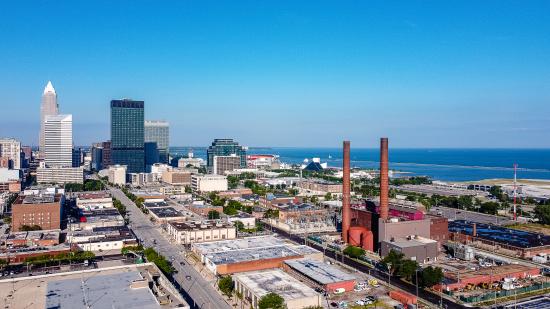
For more than a century, a district energy system has powered some of the most important buildings in downtown Cleveland, OH. Today known as Corix Cleveland Thermal, the system provides steam and chilled water to approximately 90 buildings encompassing 20 million square feet of space. Its customers include government facilities, hotels, educational institutions, apartment buildings and convention facilities relying on the system for heating and cooling.
The district energy network traces its roots to 1894, when the original steam system was established. Chilled water service followed nearly a century later in 1993. Since acquiring the system in 2015, Corix has continued operating and investing in the infrastructure. Today, the company is preparing a major modernization effort focused on the chilled water plant, ensuring the system remains reliable and expandable for decades.
Serving Downtown Cleveland with Steam and Chilled Water
Corix Cleveland Thermal serves a broad range of customers throughout downtown Cleveland. Major buildings connected to the system include Cleveland City Hall, Public Hall, Cleveland State University, the Hilton Cleveland Downtown, The 9 Hotel, the Huntington Convention Center of Cleveland, the Cuyahoga County Justice Center complex, the county administration building, the Drury Plaza Hotel, the Crowne Plaza and the downtown Cleveland Public Library.
Some customers receive steam, others receive chilled water and several receive both. Previously, the system included a second facility, but operations have since been consolidated into one plant capable of meeting the district's heating and cooling requirements.
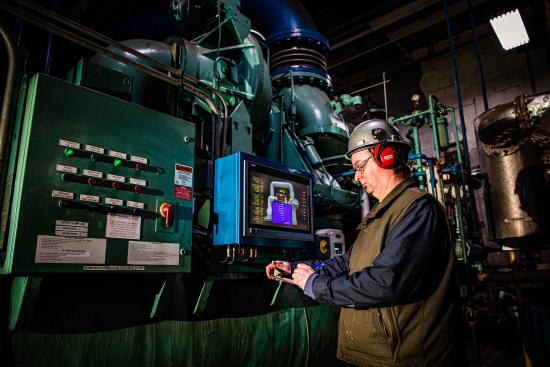
On the cooling side, the plant's major assets include two 5,000 ton electric centrifugal chillers, a 2,000 ton steam-driven chiller and a 1,500-ton electric chiller. Together, these chillers provide the capacity needed to support cooling demands across the downtown network.
Seasonal Chilled Water Operations
The chilled water system operates under two seasonal modes. During the winter season, which runs from November 1 through May 1, the system maintains chilled water temperatures between 39°F and 48°F (4°C and 9°C). Contractually, water temperatures must remain below 50°F (10°C). During the summer cooling season, from May 1 through October 1, temperature requirements become tighter. Operators maintain supply temperatures between 39°F and 42°F (4°C and 6°C) to meet customer obligations during peak cooling demand.
Weather conditions can complicate operations. Rapid swings between summer-like and fall-like temperatures are common, forcing operators to anticipate changing loads and adjust production accordingly.
The chilled water loop typically returns water from customers at roughly 50°F (10°C). The chillers then remove heat and return water to the distribution system at temperatures of 39°F to 42°F (4°C to 6°C). Typical system delta-T values range from 10°F to 12°F (6°C to 7°C) during peak summer conditions.
Centrifugal Chillers and Cooling Towers
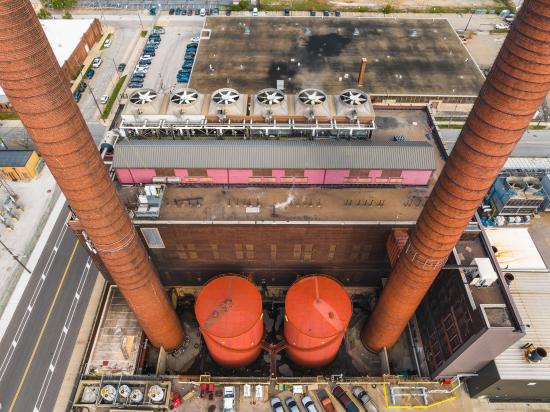
The cooling plant relies heavily on its two 5,000-ton electric centrifugal chillers. The evaporator side cools the district chilled water supplied to customers; the condenser side rejects heat to multiple large cooling towers. Two original induced-draft crossflow cooling towers using mechanically-driven fans with dual-speed operation are located on the plant roof, 80 feet above street level. Each contains three cells and was field-erected. Unlike many conventional cooling towers using standard basins, these towers were constructed with suspended concrete basins.
“They were built strong,” said Joel Bolanos, Operations Manager, Corix Cleveland Thermal. “The cooling tower system originally installed was meant to operate in the winter, as well.”
A newer cooling tower located in a nearby parking area represents a significant modernization effort. This field-erected cooling tower contains four cells. Unlike the older cooling towers, the newer cooling tower uses direct-drive fans and variable-frequency drives.
“Now, we don't need to run the fans and all the cells at all times,” Bolanos said. “We can control our leaving water temperature to a tight set point.”
The newer design offers several advantages. Direct-drive reduces maintenance requirements by eliminating mechanical linkages and gear-driven components. Variable-frequency operation improves efficiency by matching fan output to actual cooling requirements rather than relying on simple high-low control.
The cooling tower system operates with a target leaving-water temperature of 75°F (24°C). Depending on ambient conditions and load, the towers achieve temperature reductions of 10°F to 15°F (6°C to 8°C).
Winter Cooling and Condensate Recovery
One of the plant's most interesting operational strategies involves winter cooling and condensate recovery. Although some chillers were designed with free cooling capability, the system has not used that feature. Winter cooling loads occasionally exceed available free cooling capacity, and operators determined conventional chiller cycling offered greater reliability. Instead, operators closely monitor system temperatures and cycle chillers on and off as needed.
Typically, when distribution temperatures rise into the mid-40°F (7°C) range, operators start a chiller and reduce loop temperatures to 39°F (4°C) before shutting the machine down again. This approach conserves energy while protecting equipment.
Condensate recovery plays a role in the facility's water conservation strategy. Because the system operates both steam and chilled water systems, condensate generated by steam-driven equipment can be repurposed for cooling tower makeup.
“The bulk of our load comes from the steam-driven chilling,” said Masen Suddeth, Plant Engineer. “We take all that condensate, collect it in a tank and basically have it set to a float switch.”
The recovered condensate is clean and reduces dependence on municipal water supplies. “In the wintertime it can provide all of our cooling tower makeup,” Bolanos said. “So much so that I have to redirect the water sometimes because I end up overfilling the cooling towers.”
The utility estimates average chilled water plant water consumption at 1.36 million gallons per month. Makeup requirements account for less than 5% of system volume most days.
The utility partners with ChemTreat to manage its treatment program. Each cooling loop receives a combination of corrosion inhibitors and biocides tailored to seasonal conditions. Sodium hypochlorite is the primary biocide, while corrosion inhibitor formulations vary depending on operating mode and system requirements. The cooling towers operate at four cycles of concentration. The use of recovered condensate helps maintain water quality because the condensate is cleaner than incoming municipal water.
Cooling System Modernization and Future Growth
The next chapter will focus on replacing the two 5,000-ton chillers, which use refrigerants that are becoming difficult to support. The modernization project aims to reduce refrigerant risk, improve efficiency and enhance system flexibility.
Rather than replacing the existing units with identical chillers, engineers are evaluating multiple smaller chillers in the 2,500-ton range. This approach will allow them to better match cooling production with demand while increasing redundancy and flexibility.
“The main reason we're doing it is because our two largest pieces of equipment use R-22,” Suddeth said. “That’s been phased out. It can no longer be imported into the United States.”
Planning and design work are already underway. Equipment selection has not yet been finalized, but future refrigerant choices will emphasize long-term sustainability and regulatory compliance. Equally important, the project will restore expansion capability lost through decades of modifications.
“We're trying to set it up to where we can grow and make it easier for people in the future,” Bolanos said. “I want to make tomorrow easier.”
For similar articles on Centrifugal Chillers, please visit https://coolingbestpractices.com/technology/chillers.
Visit our Webinar Archives to listen to expert presentations on Centrifugal Chillers at https://coolingbestpractices.com/magazine/webinars.
