
Design Strategies to Improve Cooling Tower Performance While Reducing Water Consumption
Across industrial and commercial facilities, evaporative cooling system design is entering a new phase. For decades, water has been treated as an assumed utility input – readily available, sufficiently consistent and relatively inexpensive. System design prioritized thermal performance, while water chemistry and treatment were addressed during operation. That assumption is no longer viable.
Evaporative cooling remains one of the most efficient and widely deployed heat rejection technologies in use today. Commercial buildings, data centers, district energy systems, manufacturing facilities, food processing plants, petrochemical operations and power generation continue to rely on evaporative equipment because of its unmatched thermal efficiency. The physics haven’t changed. What has changed is the context around water.
In many regions, water availability and water quality now directly influence whether or not a cooling system can operate reliably over its service life. Increasing freshwater constraints, rising water and sewer costs, tighter discharge regulations and heightened expectations around public health and transparency have shifted water stewardship from the margins of system design to the center of it.
Today, cooling system performance, sustainability goals, regulatory compliance, risk management and long-term operating costs are tightly coupled through water quality and quantity decisions.
Water Consumption, System Operation and Cost Drivers
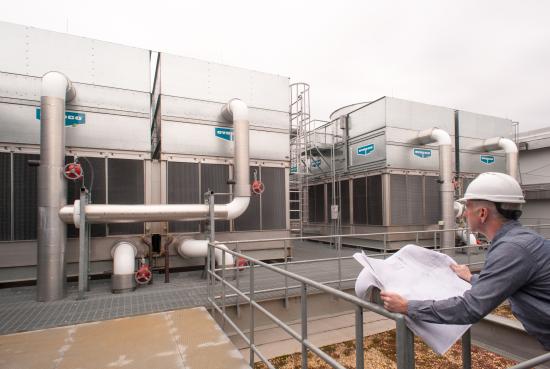
Evaporative cooling systems reject heat through the evaporation of water. That same mechanism creates a direct and unavoidable dependence on water consumption. In open cooling towers, closed-circuit coolers and evaporative condensers, water is lost through three primary pathways: evaporation, blowdown and drift. Evaporation represents the largest component and is dictated by heat load and system operating conditions.
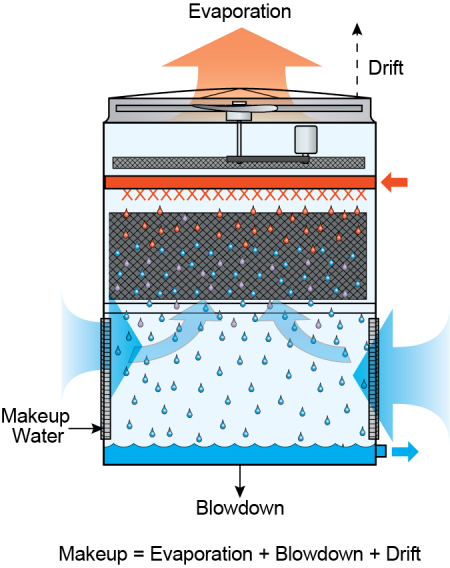
Blowdown is required to control the concentration of dissolved solids in the recirculating water, while drift accounts for small losses of entrained droplets. Makeup water is required to replace these losses and maintain system operation.
While the basic water balance is straightforward, its implications are not. As water evaporates, dissolved constituents – including but not limited to calcium, magnesium, silica, alkalinity, chlorides, sulfates and trace metals – remain behind and become concentrated in the recirculating water. This increase in dissolved solids reduces heat transfer efficiency and drives the risk of scaling, corrosion, microbiological growth and fouling.
Cycles of concentration (COC) – the ratio of dissolved solids in the recirculating water to those in the makeup water supply – define this balance. COC is essentially the balancing point between water conservation and system risk, constrained by solubility limits, system metallurgy and treatment capability. In practical terms, COC defines how many times dissolved solids are allowed to build up before water is discharged. Higher COC reduces blowdown and total water consumption, but increases the risk of deposition and corrosion. Lower cycles reduce risk but increase water usage and discharge volume.
Because evaporation is largely fixed by thermal demand, intentional blowdown becomes the primary adjustable variable.
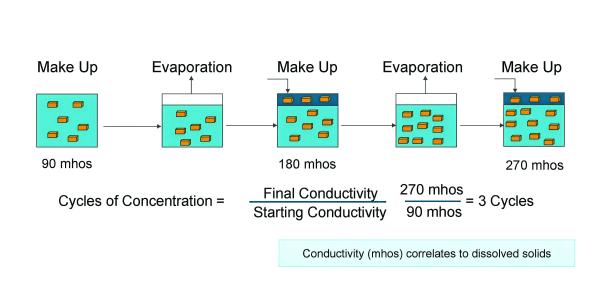
From a consumption standpoint, this has significant implications. Large evaporative systems routinely consume millions of gallons of water annually, with total usage driven by both evaporation losses and the intentional blowdown required to maintain acceptable water chemistry. As cycles are reduced or variability increases, blowdown volume – and therefore total water consumption – rises accordingly.
Economic impact follows directly. The cost of water is no longer limited to supply. It also includes:
- Incoming water cost
- Sewer and discharge fees
- Treatment and chemical costs
- Compliance and risk management
In many regions, combined water and sewer costs now represent a major operating expense, often rivaling or exceeding treatment program costs. This economic pressure, combined with supply constraints, is a primary driver behind the increasing adoption of alternative water sources (AWS).
AWS is any non-traditional makeup water supply used in place of, or in addition to, potable or municipal water. The specific source or sources used depends on site availability, water quality and quantity requirements and economic feasibility, typically requiring evaluation and treatment to ensure compatibility with system design, metallurgy and operating conditions.
Alternative Water Sources in Evaporative Cooling
The growing adoption of AWS to supplement or replace municipal makeup requirements in evaporative cooling is a direct response to the cost, availability and consumption challenges outlined previously. As water availability becomes less predictable, and as both water procurement and sewer discharge costs continue to rise, the economics of cooling system operations are shifting. Within this context, AWS is not just a sustainability initiative – it’s a practical response to cost, availability and long-term operational resilience. However, each source must be evaluated not only for availability, but for how its chemistry behaves under concentration within cooling systems, and must be engineered deliberately.
Reclaimed Municipal Wastewater. Reclaimed municipal wastewater offers one of the most reliable AWS supply streams in terms of volume and availability. Its adoption is often driven by cost and access, particularly in regions where potable water is constrained or cost-prohibitive. However, this reliability in supply is offset by variability in composition. Elevated nutrients, dissolved solids and organic content introduce biological pressure, increased oxidant demand and tighter limits on achievable COC. Its successful use depends on designing for these conditions – not assuming they can be corrected downstream. Successful reclaimed water integration typically requires filtration plus disinfection, with additional conditioning or desalting based on target cycles and discharge constraints.
Harvested Rainwater and Stormwater. Rainwater and stormwater are attractive from both a cost and sustainability perspective, particularly where capture infrastructure already exists or for facilities with large roof areas. It’s often one of the most institutionally supported alternative water strategies, particularly where stormwater management requirements and potable water reduction mandates align.
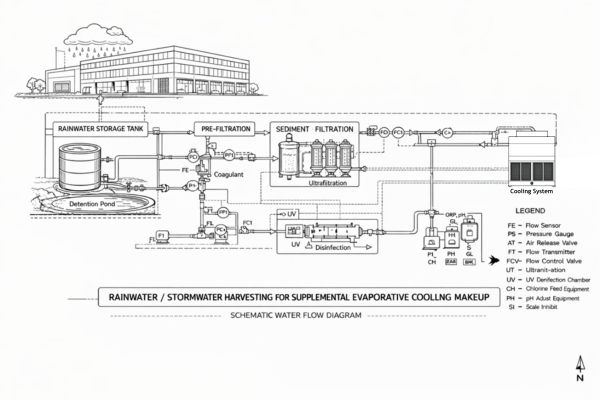
However, their intermittent nature introduces both supply and quality variability. First-flush contamination, debris and atmospheric deposition can significantly impact water quality. Chemically, rainwater is typically low in hardness and total dissolved solids (TDS), which can support higher achievable COC. However, low mineral content does not eliminate operational risk. These sources can be corrosive and inconsistent without proper conditioning or chemical pretreatment. Roof runoff can introduce suspended solids, organic debris, trace metals from roofing materials and microbial contamination.
Seasonality is a primary design constraint. Rainfall patterns rarely align with peak evaporative demand. Storage systems must be engineered to prevent stagnation, starvation and sediment accumulation during low-turnover periods. As a result, rainwater is most reliable when treated as a supplemental or blended source rather than a sole supply. Additionally, the capital investment and floor space required to properly capture, store and treat harvested rainwater or stormwater can be significant.
When integrated deliberately, rainwater harvesting can reduce potable water demand without introducing the nutrient variability associated with some reclaimed sources. Its role is often best suited as a supplemental source, supported by storage and equalization to manage variability.
HVAC Condensate Capturing. HVAC and process condensates are among the highest-quality AWS available. The low hardness and TDS concentration make condensate attractive as blending streams, reducing blowdown and improving system efficiency. Economically, they represent water that’s already been paid for. However, the same low mineral content makes condensate chemically aggressive, requiring robust corrosion control. In cooling applications, condensate is most effective when blended with sources with higher TDS to reduce makeup conductivity and increase achievable COC.
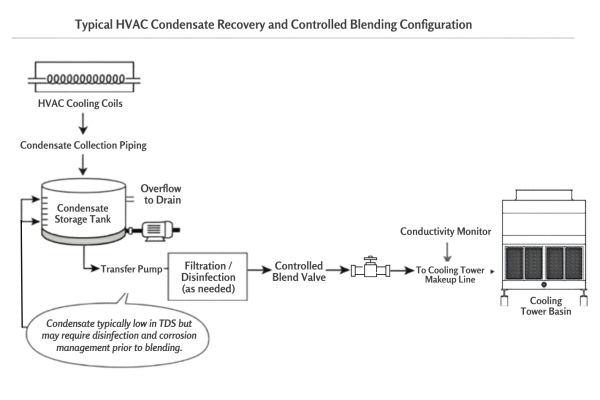
Not all condensate is created equal. While HVAC cooling-coil condensate is typically low in hardness and only mildly acidic, condensate from combustion sources can contain acidic byproducts. These streams present a significantly higher corrosion risk. For this reason, combustion-derived condensate should never be reused without thorough evaluation.
Graywater. Graywater reuse can be attractive in facilities with high shower, laundry or process wash loads, particularly on campuses and in large commercial buildings. In practice, however, graywater is one of the most variable AWS options.
Surfactants, oils and biodegradable organics, combined with intermittent loading, create a highly dynamic water profile. In evaporative systems, this variability can accelerate foaming, fouling and biological growth, while also increasing oxidant demand and treatment complexity. As a result, graywater typically requires robust pretreatment and advanced filtration before it’s stable enough for consistent, year-round use for cooling makeup.
While many graywater reuse projects are technically feasible, they’re often operationally demanding. Facilities that succeed approach graywater as a managed process stream, not as a passive reuse opportunity.
Process Wastewater and Internal Reuse. Process wastewater and cooling system blowdown represent high-impact opportunities for freshwater demand reduction. However, these streams are inherently elevated in dissolved solids and may contain treatment residuals, metals and organic constituents. Absent appropriate conditions, reuse does not eliminate risk – it redistributes it, frequently manifesting as increased deposition potential, corrosion risk or fouling in downstream equipment.
Implementation of blowdown reuse typically necessitates advanced treatment to reliably control constituent levels and stabilize water chemistry. Advanced treatment of these water sources, such as reverse osmosis, is commonly applied. System design must carefully evaluate concentrate management, fouling and scaling potential, pretreatment water use and overall lifecycle costs.
Brackish Groundwater and Desalination. Brackish groundwater can be a stable supply in some regions, but high salinity, chlorides, sulfates and silica often cap achievable cycles quickly. Reverse osmosis can produce usable makeup water, but energy consumption, pretreatment needs and concentrate disposal must be evaluated as part of the total system design.
The Common AWS Constraint: Variability
Across all AWS, the defining characteristic is not a specific contaminant – it’s variability. Unlike traditional water supplies, AWS introduces continuous fluctuations in nutrient loading, biological activity, organic content and dissolved and suspended solids. These shifts directly influence fouling potential, microbiological growth and scaling and corrosion behavior within the cooling water system.
Engineering for variability requires a shift in mindset from static design to adaptive operation. Characterization must extend beyond single-point analyses to include ranges, frequencies and rates of change across key parameters. Treatment systems must be selected and sized not only for expected loads, but for peak conditions and transient events. Controls must move beyond fixed setpoints to responsive strategies that adjust based on real-time system feedback. Filtration, chemical feed and monitoring infrastructure must be integrated in a way that allows the system to absorb and respond to variability without destabilizing.
Ultimately, variability is not a secondary consideration in AWS – it’s the defining constraint governing system performance. Systems acknowledging and designing around this constraint can operate reliably, even with high dynamic water sources or variable loading profiles. Systems that don’t will be continuously reactive to symptoms rather than controlling the underlying process.
Why AWS Projects Fail More Often than Expected
Most AWS projects fail because variability is acknowledged in theory but not fully accounted for in design and operation.
A common failure pattern includes:
- AWS is characterized by limited or average water quality data
- Treatment systems are sized for steady-state conditions and assumptions
- Control strategies rely on fixed setpoints rather than adaptive logic
- Upset conditions are considered infrequent rather than inherent
In reality, water quality is dynamic. Seasonal variation, intermittent contamination loading and changing oxidant demand introduce variability that must be anticipated and managed. When systems aren’t designed to handle this variability, operators are forced into reactive control rather than stable operation.
Importantly, scaling, corrosion, microbiological growth and fouling are not inevitable outcomes of AWS use. These risks are manageable with a water treatment program properly designed for both the cooling system and the actual makeup water chemistry. However, as variability increases, so does the need for alignment between system design, control strategies and treatment approaches.
Another common misstep is treating AWS as something only to use when they happen to be available. In evaporative cooling, that approach is fundamentally flawed. These systems are continuous consumers of water, and any alternative source must be integrated with the expectation of a reliable, consistent supply, at whatever level of redundancy and assurance each facility or location requires. Intermittent use without a defined supply strategy introduces instability into both system operation and water chemistry control.
This ties directly into a broader issue: implementing AWS as a water treatment add-on rather than a system-level design consideration. Treatment may be addressed, but hydraulics, storage, filtration, drift control, instrumentation and operational practices remain unchanged. Without the necessary infrastructure – storage, capacity, blending strategies, backup supply integration and controls – systems only meet targets theoretically, but lack resilience under real-world operating conditions.
The reality is straightforward: One plus one does not equal two. Without designing for consistent supply and the infrastructure to support it, AWS introduce variability faster than treatment programs can compensate for it.
Return on Investment: Fit-for-Use and Economic Alignment
Not all AWS are appropriate for all systems. Successful implementation requires alignment between water quality, system design, treatment capability and economic objectives. While AWS can reduce potable water demand and lower water and sewer costs, it often introduces increased system complexity and higher treatment requirements. The value of any AWS strategy is determined by how well these factors are balanced. When properly aligned, AWS can improve both economic performance and system reliability. When they’re not, they can introduce instability outweighing their intended benefits. AWS projects evaluated solely on first cost or short-term water savings often disappoint. A meaningful economic analysis includes capital cost, operating cost, avoided cost and sensitivity to water and price escalation. Just as important, it considers the cost of not having water when it’s needed.
Fit-for-use is the technical foundation of this alignment. Cooling systems don’t require clean water in an absolute sense. They require water that’s predictable and controllable within the limits of the system’s materials, hydraulics and treatment program. An alternative source that meets volume requirements but introduces wide swings in quality may satisfy supply objectives while undermining system stability. Conversely, a source that is more complex but consistent – when paired with appropriate pretreatment and control – can outperform a higher-quality but less reliable supply. The evaluation, therefore, is not absolute water quality; it’s about compatibility with the system’s ability to manage quality over time.
This is where economics moves beyond simple substitution. AWS doesn’t replace one water cost with another. It reshapes the entire cost structure of the cooling system. Capital investment often increases, driven by storage, conveyance and pretreatment infrastructure such as filtration, softening or membrane systems. Instrumentation and controls also expand, as variability demands better monitoring and more responsive operation. These costs are often front-loaded and highly visible, which is why AWS can appear unfavorable in early-stage evaluations.
Operating costs, however, tell a more nuanced story. Chemical demand may increase due to higher oxidant demand or deposition potential, but this isn’t universally true. Well-designed pretreatment can stabilize influent quality and reduce downstream variability, lowering total chemical consumption over time. Energy costs may rise due to pumping or treatment processes, but can be offset by improved COC or reduced blowdown if water chemistry is effectively controlled. Maintenance costs often increase in systems not designed for variability, but in systems that are, maintenance becomes more predictable and less reactive. The distinction is not the source itself – it’s whether the system was engineered to handle it.
Economic Planning with an Eye to Future Variability
Avoided costs are a critical and frequently underweighted component of AWS economics. Reductions in potable water purchase and sewer discharge are the most obvious, but they’re only part of the picture. AWS can mitigate exposure to water restrictions, discharge limitations and future regulatory pressures. In regions where water pricing is escalating or becoming more volatile, AWS acts as a hedge against future cost uncertainty. It also reduces dependency on a single supply, which has both economic and operational value. These avoided costs don’t always appear on a utility bill, but they materially affect long-term financial performance.
Lifecycle economics is where AWS decisions are won or lost. A system designed for 20 to 30 years of operation will experience changes in water pricing, discharge regulations and system demand that can’t be captured in a simple payback calculation. Sensitivity analysis becomes essential: What happens if water costs double, if discharge limits tighten or if production increases? AWS strategies appearing marginal under current conditions often become favorable under realistic future scenarios. Conversely, systems relying on optimistic assumptions about water quality, water stability or low operating costs can quickly become liabilities.
Equally important is the cost of unreliability. Cooling systems are not optional infrastructure; they’re integral to process stability, production capacity and equipment life. An AWS system intermittently failing to meet demand, or introducing conditions driving deposition, corrosion, biological excursions or fouling, carries a cost that far exceeds water savings. Lost production, emergency maintenance, accelerated asset degradation and increased operator intervention all have measurable economic impact. In this context, resilience is not an abstract benefit, but a quantifiable component of lifecycle cost.
Ultimately, the success of an AWS program depends on designing and operating a system that can reliably manage water quality variability while aligning lifecycle costs with performance and risk tolerance from the outset. Fit-for-use ensures water can be managed within the system. Economic alignment ensures the system can be justified and sustained over its full lifecycle. When both are addressed together, AWS becomes more than a sustainability measure; it becomes a strategic asset enhancing operational stability, reducing long-term cost exposure and providing flexibility in an increasingly constrained water landscape.
About the Author

Nicole Babb is a water systems and water treatment specialist with expertise in industrial water treatment, cooling system design and alternative water source implementation. She serves as a North American Product Manager for EVAPCO Water Systems, where she works at the intersection of engineering, water chemistry and system performance to help facilities optimize reliability, efficiency and water use. With a background spanning mechanical systems, water treatment strategy and applied cooling technology, she focuses on real-world challenges facing evaporative cooling systems, including scaling, corrosion, microbiological control and the integration of non-traditional water sources.
About EVAPCO
EVAPCO provides a full spectrum of global product solutions for the commercial HVAC, industrial refrigeration, power generation and industrial process markets with 500 active patents on the market today. Headquartered in Taneytown, MD, the company’s products are engineered and manufactured in 36 locations in 14 countries and supplied through a sales network of more than 170 offices. For more information, visit https://www.evapco.com.
To read articles about Water Savings, visit https://coolingbestpractices.com/system-assessments/water-savings.
Visit our Webinar Archives to listen to expert presentations on Water Savings at https://coolingbestpractices.com/magazine/webinars.
