
Water Savings
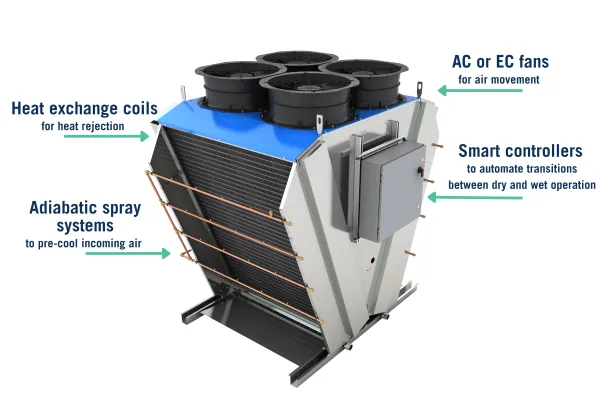
As facility managers, industrial engineers and procurement professionals strive to meet rising demands for energy efficiency, water conservation and sustainability, cooling systems have taken center stage. Among the various technologies reshaping the industrial and commercial cooling landscape, adiabatic cooling stands out as a compelling alternative to traditional methods.
This article explores the evolving role of adiabatic cooling, its technical advantages and why it's gaining traction across industries.
The CHS oil refinery in McPherson, KS, is a 550-acre facility that processes 100,000 barrels of crude oil per day, consisting of an even mix of sweet crude oil and sour crude oil. Crude is brought in through pipelines and fractionated into gasoline, diesel and a few other products. The refinery also houses a sulfur plant where it produces a liquid agricultural fertilizer called ATS or ammonium thiosulfate, which uses sulfur removed primarily through a process called hydrotreating.
[ Read Full Story ]
The selection criteria for the hybrid fluid cooler considered year-round temperatures. Summer duty had an entering water temperature of 95°F (35°C) and a leaving water temperature of 85°F (29°C). In winter, the wireless provider could use the fluid cooler for direct free cooling, meaning it could send water directly through the fluid cooler, bypassing the chiller. Entering water temperature was 55°F (13°C) and leaving water temperature was 44°F (7°C).
[ Read Full Story ]
Dry fluid coolers use ambient air to reject heat from hot process fluids running through the unit’s closed-circuit coil heat exchanger. Dry coolers have either flat or V-shaped configurations. Hybrid fluid coolers combine closed-loop dry cooling with evaporative cooling for an efficient design that uses less water. Hybrids can be run in dry mode when the temperature set point can be met by dry cooling alone. Adiabatic coolers are a type of dry cooler that use some water to pre-cool the ambient air used to reject heat from the process fluid.
[ Read Full Story ]
Water conservation is a high priority in designing and operating water-cooled equipment and plays an important role in USGBC’s Leadership in Energy and Environmental Design (LEED) certification and other sustainability programs. LEED assigns credit points to reduce water usage.
[ Read Full Story ]
An Illinois food service products manufacturer now saves nearly 60% of their base annual cooling energy costs through improvements made in three phases over several years. The plant, which has a 1200 ton chilled water plant, implemented upgrades including pump and tower fan VFDs and enhanced function controls, free cooling, and chiller compressor drive retrofits. The revisions built through successive phases to capture further benefits from more complete utilization of the preceding steps’ capabilities.
[ Read Full Story ]
Free cooling can take two different forms: air-side economizers that directly exchange cool outdoor air with the building or water-side economizers that use outdoor air to cool the chilled water used to cool the building. This article focuses on water-side economization in particular using two different methods: stand-alone dry coolers and air-cooled chillers with integrated free cooling coils.
[ Read Full Story ]
Chiller & Cooling Best Practices Magazine spoke with Tom Pagliuco, Executive Director Global Energy Engineering at AbbVie, Inc. about best practices for optimizing chilled water systems in today’s pharmaceutical operations.
[ Read Full Story ]
For U.S. Flue-Cured Tobacco Growers, Inc. (USFCTG) sustainability is a guiding practice for tobacco production from seed to delivery. So when traditional chemical water treatment had proven problematic in air washers at its plant in Timberlake, North Carolina, the company thought outside the box for solutions to address a variety of issues while also supporting its sustainability goals.
[ Read Full Story ]
Do water-cooled chiller plants still deliver lower utility bills? Today, many chiller plant energy analyses carefully account for energy costs, and even energy escalation rates – a factor that projects how fuel costs will increase over time, while ignoring water and wastewater costs associated with cooling towers. While highly effective at transferring heat, cooling towers consume millions of gallons of water each year through the process of evaporation, drift, and blowdown. With the rising cost of water and wastewater, this omission can result in an incomplete picture for the building owner.
[ Read Full Story ]