
Technology
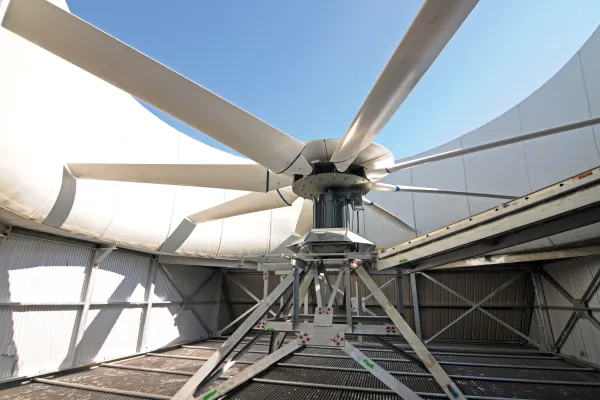
Across industries, operators are adopting cooling tower direct drive (CTDD) motor technology. In particular, permanent magnet (PM) direct drive motors are delivering measurable improvements in efficiency, cleanliness and maintenance reduction. The change is more than a component swap; it represents a new approach to cooling tower design that reduces operating costs, supports environmental goals and improves reliability.
The selection criteria for the hybrid fluid cooler considered year-round temperatures. Summer duty had an entering water temperature of 95°F (35°C) and a leaving water temperature of 85°F (29°C). In winter, the wireless provider could use the fluid cooler for direct free cooling, meaning it could send water directly through the fluid cooler, bypassing the chiller. Entering water temperature was 55°F (13°C) and leaving water temperature was 44°F (7°C).
[ Read Full Story ]
If we're using sustainability as a broader term, there's waste management, water, carbon, renewable power and more. Those are some of the units now part of the equation we're solving for. It sometimes ends up with a different set of solutions than you would typically end up with if you were only looking at dollars.
[ Read Full Story ]
This article will make plants aware of the energy and water use differential between CHW systems providing chilled water in a 45-60°F (7-16°C) range, and process cooling solutions at 70°F up to 120°F (21 to 49°C). The article will examine cooling resource evaluation criteria and supply water temperature specifications, then describe and compare process cooling options.
[ Read Full Story ]
This article will make plants aware of the energy and water use differential between CHW systems providing chilled water in a 45-60°F (7-16°C) range, and process cooling solutions at 70°F up to 120°F (21 to 49°C). The article will examine cooling resource evaluation criteria and supply water temperature specifications, then describe and compare process cooling options.
[ Read Full Story ]
This article will make plants aware of the energy and water use differential between CHW systems providing chilled water in a 45-60°F (7-16°C) range, and process cooling solutions at 70°F up to 120°F (21 to 49°C). The article will examine cooling resource evaluation criteria and supply water temperature specifications, then describe and compare process cooling options.
[ Read Full Story ]
Bayer Crop Science runs a 240-acre fertilizer production facility with areas for active ingredient and chemical intermediate production, as well as a high-active herbicide production unit. Among the multiple cooling towers at the facility was a 40-year-old field-erected, three-cell, wooden, crossflow Marley cooling tower used for rejecting heat and providing cooling for multiple processes.
[ Read Full Story ]
Heat pumps have found growing popularity as a high-efficiency solution for cooling and heating. With greater public awareness and organizational emphasis on sustainability, these systems are a viable upgrade to a wide range of processes, from residential climate control to industrial heating and cooling applications. The flexible functionality of heat pumps – namely their ability to reverse the traditional vapor-compression cycle – offers them significant advantages over refrigerant and combustion-based systems.
[ Read Full Story ]
The customers wanted to be able to monitor their system from a control room. They wanted to be able to see the overall view of how the system was running. The bigger thing on the backend – especially for us from an engineering perspective – was being able to do better troubleshooting and helping them without the need to be onsite.
[ Read Full Story ]
Dry fluid coolers use ambient air to reject heat from hot process fluids running through the unit’s closed-circuit coil heat exchanger. Dry coolers have either flat or V-shaped configurations. Hybrid fluid coolers combine closed-loop dry cooling with evaporative cooling for an efficient design that uses less water. Hybrids can be run in dry mode when the temperature set point can be met by dry cooling alone. Adiabatic coolers are a type of dry cooler that use some water to pre-cool the ambient air used to reject heat from the process fluid.
[ Read Full Story ]
Dry fluid coolers use ambient air to reject heat from hot process fluids running through the unit’s closed-circuit coil heat exchanger. Dry coolers have either flat or V-shaped configurations. Hybrid fluid coolers combine closed-loop dry cooling with evaporative cooling for an efficient design that uses less water. Hybrids can be run in dry mode when the temperature set point can be met by dry cooling alone. Adiabatic coolers are a type of dry cooler that use some water to pre-cool the ambient air used to reject heat from the process fluid.
[ Read Full Story ]