Industrial Utility Efficiency

Technology

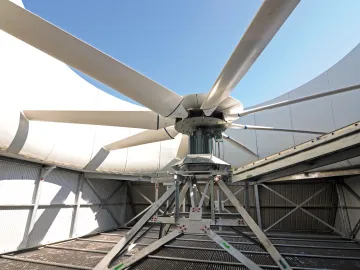
Across industries, operators are adopting cooling tower direct drive (CTDD) motor technology. In particular, permanent magnet (PM) direct drive motors are delivering measurable improvements in efficiency, cleanliness and maintenance reduction. The change is more than a component swap; it represents a new approach to cooling tower design that reduces operating costs, supports environmental goals and improves reliability. 

Water conservation is a high priority in designing and operating water-cooled equipment and plays an important role in USGBC’s Leadership in Energy and Environmental Design (LEED) certification and other sustainability programs. LEED assigns credit points to reduce water usage. 
The need for cooling capacity is increasing globally. An expanding population and an ever-growing dependence on data increases the need for process cooling, centralized space cooling, and data center cooling. Meanwhile, in many places, water scarcity is a massive issue. In conventional, industrial cooling applications, the use of water for heat rejection is critical. Cooling towers and most evaporative fluid coolers depend heavily on water to reject waste heat to the atmosphere.
The mission of CTI is to advocate and promote the use of all environmentally responsible commercial cooling technologies. Three committees make up CTI’s primary working groups - Engineering, Standards & Maintenance (ESM); Performance & Technology (P&T); and Water Treatment (WT). The conference featured over 35 presentations by recently published technical paper authors from the industry. 
The 2023 AHR Expo co-sponsored by ASHRAE and AHRI was held Feb. 6-9 at the Georgia World Congress Center in Atlanta, GA. A total of 1,779 exhibitors (425 international) spread across 487,000 square feet, and several dozen free educational sessions drew 42,794 total attendees. HVACR equipment manufacturers and suppliers displayed their latest innovations engineered to address the megatrends in the HVACR industry and market. This report will highlight the cooling tower, chiller/heat pump and associated technology innovation centered around electrification, decarbonization and water conservation.
This article will be of particular interest to industrial system operators unfamiliar with tankless (primarily closed) systems who may be considering either installing new systems without tanks or removing existing open tanks.  The topics covered step through an understanding of tankless systems while also including tank system pointers and insights on converting systems with tanks into tankless systems. 
This article will explore the Cooling Technologies Institute (CTI) Standard 201 (STD-201) Thermal Certification This article will explore the Cooling Technology Institute (CTI) Standard 201 (STD-201) Thermal Certification Program, share perspective from leading cooling tower manufacturers, and cover other existing and evolving CTI test codes, standards and certifications. This article will also emphasize the investment and bandwidth contributed to CTI by cooling tower manufacturers for the benefit of the industry and its end users. 
This article will explore why tanks are used in cooling systems, why they might not be used in cooling systems, and finally considerations to be evaluated in determining if tanks are needed in any particular central plant cooling system. Part 2 will review specific application details for using tanks and also for tankless systems and system conversions.

Chillers

This article will make plants aware of the energy and water use differential between CHW systems…

Cooling Towers

Bayer Crop Science runs a 240-acre fertilizer production facility with areas for active ingredient…

Fluid Coolers

This article explores how air-cooled heat rejection systems are reshaping industrial cooling…

Dry Coolers

Adiabatic coolers are rapidly gaining ground in plastics processing as manufacturers seek…

Water Filtration

Field-erected evaporative “wet” cooling towers, combined with heat exchangers, are an economical…

Heat Exchangers

Free cooling offers a highly efficient alternative to chiller-based cooling, but its success…

Cooling Controls

The customers wanted to be able to monitor their system from a control room. They wanted to be able…