Industrial Utility Efficiency

Technology

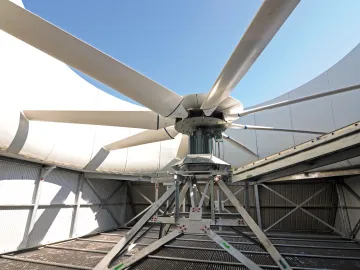
Across industries, operators are adopting cooling tower direct drive (CTDD) motor technology. In particular, permanent magnet (PM) direct drive motors are delivering measurable improvements in efficiency, cleanliness and maintenance reduction. The change is more than a component swap; it represents a new approach to cooling tower design that reduces operating costs, supports environmental goals and improves reliability. 
An Illinois food service products manufacturer now saves nearly 60% of their base annual cooling energy costs through improvements made in three phases over several years. The plant, which has a 1200 ton chilled water plant, implemented upgrades including pump and tower fan VFDs and enhanced function controls, free cooling, and chiller compressor drive retrofits. The revisions built through successive phases to capture further benefits from more complete utilization of the preceding steps’ capabilities.
The Sterling Heights facility, producing jet engines for the U.S. Army, has undergone extensive overhauls and re-tooling in the last decade. In 2010, Stellantis announced it would invest nearly $850 million in a new state-of-the-art paint shop at the SHAP Site, as well as the installation of new machinery, tooling and material-handling equipment. The following year, the company added another $165 million to the investment to build a one million-square-foot body shop. 
The electrification of heating presents a significant opportunity to achieve decarbonization goals by reducing or eliminating the use of fossil fuels in traditional building systems such as boilers. The current geopolitical scenario has caused commodity prices to quickly rise and forced businesses, cities and countries to rethink their future dependance on fossil fuels and accelerate the conversion to sustainable alternatives.
In June 1920, Willis Haviland Carrier prepared a memo that described a novel machine and refrigerant that might significantly advance the art and science of air conditioning.  Already celebrated for his 1911 “Rational Psychrometric Formulae,” Carrier imagined a “centrifugal chiller” and new refrigerant that would not only enhance process cooling in factories around the world, but reliably and affordably deliver “comfort air” to the public in theaters, stores, restaurants, sports venues, ships, hospitals and office buildings. 
The 2022 AHR Expo co-sponsored by ASHRAE and AHRI was held Jan. 31 – Feb. 2, at the Las Vegas Convention Center. A total of 1,573 exhibitors (281 international) spread out over 440,000 square-feet, and 80 free sessions in the Education Program drew more than 30,000 attendees to the event. Common trends discussed amongst exhibitors focused on energy efficiency, operational reliability, connectivity and new chiller refrigerant transitions spurred by approaching regulatory transition dates in the AIM Act enacted by US Congress in late 2020. 
Like many universities across America, The University of Cincinnati had a major challenge having to operate aging central utility plants with older technology, reduced efficiencies and capacities, with chilled water equipment at the end of its service life. Even so, UC needed to maintain plant operations under diverse load conditions, including critical hospital utility demands that are currently expanding and in daily periods subject to energy tariff.
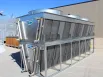
Free cooling can take two different forms: air-side economizers that directly exchange cool outdoor air with the building or water-side economizers that use outdoor air to cool the chilled water used to cool the building. This article focuses on water-side economization in particular using two different methods: stand-alone dry coolers and air-cooled chillers with integrated free cooling coils. 

Chillers

This article will make plants aware of the energy and water use differential between CHW systems…

Cooling Towers

Bayer Crop Science runs a 240-acre fertilizer production facility with areas for active ingredient…

Fluid Coolers

This article explores how air-cooled heat rejection systems are reshaping industrial cooling…

Dry Coolers

Adiabatic coolers are rapidly gaining ground in plastics processing as manufacturers seek…

Water Filtration

Field-erected evaporative “wet” cooling towers, combined with heat exchangers, are an economical…

Heat Exchangers

Free cooling offers a highly efficient alternative to chiller-based cooling, but its success…

Cooling Controls

The customers wanted to be able to monitor their system from a control room. They wanted to be able…