Industrial Utility Efficiency

Technology

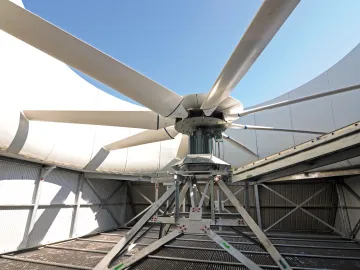
Across industries, operators are adopting cooling tower direct drive (CTDD) motor technology. In particular, permanent magnet (PM) direct drive motors are delivering measurable improvements in efficiency, cleanliness and maintenance reduction. The change is more than a component swap; it represents a new approach to cooling tower design that reduces operating costs, supports environmental goals and improves reliability. 

Chiller & Cooling Best Practices Magazine interviewed Paul Heston (General Manager) and Tom Strock (Chief Engineer) from Hydrothrift Corporation. In a nutshell, where workers are exposed to harmful chemicals, they must have eyewash and safety shower stations to decontaminate themselves in the event of a spill or splash. A variety of industries, including petrochemical, chemical, metal fabrication and laboratories, must plan for this contingency. The ANSI Z358.1 Standard specifies the water used for these purposes must be tepid or within a site-specified range.  This means in colder climates, water must be heated, and in hotter climates water must be cooled.  
Gearboxes are used as speed reducers to slow the rotational speed from the incoming motor to the outgoing fan of a cooling tower. Companies operating high-capacity production plants, such as those in the chemical process and power industries, require cooling towers with large amounts of heat rejection capacity. Without gearbox technology, cooling tower motors would be massive to directly handle the torque required by the fan. Something so large and heavy would be too expensive and impractical.
Manufacturers are under continual pressure to control costs without affecting operations or worker comfort and safety. Because energy ranks as one of the largest operating expenses, improving energy efficiency of mechanical cooling systems is one of the best ways to reduce operating costs. In a typical water-cooled chiller plant, the chiller itself accounts for most of the energy consumption. That’s why improving chiller efficiency is critical to controlling operating costs.
The demand for advanced computing power rises year after year, but the more powerful the system, the more heat it generates. As data centers grow, they place higher demands on cooling equipment. Packing as much kilowatt and computer usage into as small a space as possible is key to reducing the cost and size of the facility. In doing this, data centers increase the power density of their systems, drawing more power, and generating more heat per unit area.
ElectroCell Systems, Inc., manufactures a system for commercial, industrial and institutional facilities that is applied to conventional water-cooled chilled water plants. The system significantly improves efficiency in water and energy use with paybacks in the 2.0 to 3.5 year range. The system is not a substitute for chemical treatment; rather it is a Condenser Water Efficiency system, engineered specifically and solely to increase water and energy efficiency by addressing the uniquely challenging demands that exist only in the condenser water loop.
If you enjoy the occasional beverage from an aluminum can, there’s a decent chance the can was made by Ball Corporation, a container manufacturing giant with facilities across the world. The company’s facility in Saratoga Springs, New York, services beverage companies throughout the northeastern United States. The plant operates four production lines producing millions of aluminum cans per day.
The temperature of wine must be kept stable throughout its production and storage in order to ensure final product quality that is acceptable for distribution and sale, and so cooling systems are an integral component of wine production. In wineries, the entire harvest can be destroyed by a temperature fluctuation during processing or storage, leading to catastrophic consequences for wineries.
The number of data centers in the United States continues to grow in response to the enormous amount of digital information stored and streamed. The massive computer power within these data centers generates heat, making efficient cooling a key building system requirement. Evaporative cooling towers are an integral part of many data center cooling systems.
Recent developments in factory-assembled cooling tower technology can increase cooling capacity per cell by up to 50%, expanding the applications for so called “package” towers supporting HVAC and industrial processes. Although field-erected towers have long been the preferred product for process cooling in power plants and heavy industry, new robust designs and materials coupled with cost-saving building techniques now make a new generation of modular products logical alternatives for a broader range of applications.  

Chillers

This article will make plants aware of the energy and water use differential between CHW systems…

Cooling Towers

Bayer Crop Science runs a 240-acre fertilizer production facility with areas for active ingredient…

Fluid Coolers

This article explores how air-cooled heat rejection systems are reshaping industrial cooling…

Dry Coolers

Adiabatic coolers are rapidly gaining ground in plastics processing as manufacturers seek…

Water Filtration

Field-erected evaporative “wet” cooling towers, combined with heat exchangers, are an economical…

Heat Exchangers

Free cooling offers a highly efficient alternative to chiller-based cooling, but its success…

Cooling Controls

The customers wanted to be able to monitor their system from a control room. They wanted to be able…