Industrial Utility Efficiency

Technology

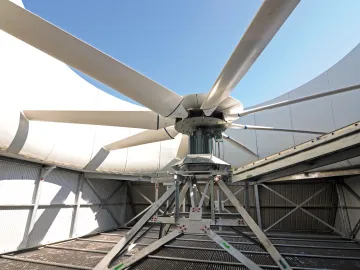
Across industries, operators are adopting cooling tower direct drive (CTDD) motor technology. In particular, permanent magnet (PM) direct drive motors are delivering measurable improvements in efficiency, cleanliness and maintenance reduction. The change is more than a component swap; it represents a new approach to cooling tower design that reduces operating costs, supports environmental goals and improves reliability. 

Mars is that much closer. The journey toward new human exploration missions beyond Earth’s orbit took a major step forward on June 28 with the successful completion of the second and final qualification test of a five-segment rocket motor for NASA’s heavy-lift Space Launch System (SLS). The motor manufacturer, Orbital ATK, based in Dulles, Va., recently confirmed the QM-2 motor performed as designed.
The Smardt Chiller Group has manufacturing operations in North America, Asia Pacific, China and Europe.  Our main North American plant and headquarters is in Dorval (Quebec) complemented by our Plattsburgh (New York) plant which serves government and other clients requiring a “Made in the U.S.A.” certificate.  Asia Pacific manufacturing is done in Melbourne (Australia) and we have launched a manufacturing plant in Guangzhou to serve China. The European market is served out of our plant in Stuttgart (Germany).  North America and Asia Pacific make up 80% of our business with the balance coming from Europe and China –which are our fastest-growing geographies.
We are certain it comes as no surprise to the readership of this journal that a third of the total energy end use for commercial buildings in the U.S. is consumed by HVAC (DOE 2008). Chillers are usually the single largest individual user of electricity in commercial and institutional HVAC facilities. Maintenance and engineering managers have three primary options to improving chiller performance: replacement, control strategies and maintenance. As chillers are required to reject heat to complete the vapor-compression cycle, a condenser heat exchanger is used which allows heat to migrate from the refrigerant gas to either water or air. Heat transfer has the greatest single effect on chiller performance.
Anecdotal reports from users of Tower Tech cooling towers across the U.S. have indicated the Tower Tech design provides substantial savings to the customer both in terms of lower chemical treatment requirements and substantial water savings. There are a number of mechanisms by which the Tower Tech design facilitates efficient, lower cost water treatment and usage. A few are described in this article.
While the chiller is the heart of a chilled water system, its support system of components and controls are equally critical to maintain and manage to ensure the highest system efficiency levels are attained. Emphasis is often placed on the chiller since it is the most visible and typically the highest energy element of a chilled water system. Yet, if you look beyond the flanges, there’s an opportunity to improve delivery of chilled water to the airside or process loads and maximize system efficiency.  
Plastics processors are looking to advanced process cooling equipment to lower operational costs, and in many cases, improve the quality of products and achieve sustainability goals. But it’s more than just a matter of finding a better mousetrap and putting systems to work. Instead, it requires a keen understanding of the processes involved, followed by the design and installation of advanced technology in combination with the right process cooling systems matched to a company’s goals.
Physics teaches us that water, when evaporating in an adiabatic system, removes sensible heat from such system. The temperature thus decreases. In order for the water to evaporate, energy is required, specifically 2501 kilojoules for each kilogram of evaporated water. In the absence of an external energy source, the water absorbs the required energy from the environment, in this case from the surrounding air. As a consequence, the air is cooled. In simple terms, it can be stated that evaporation of water converts the sensible heat of the air (temperature) into latent heat (humidity). As a result, the system is cooled and humidified at the same time. This type of cooling is referred to in literature as evaporative cooling or adiabatic cooling.
Intelligent process cooling describes an approach to cooling in beverage production and packaging that moves beyond evaporative cooling towers and the use of traditional central chiller systems that rely on ammonia as a refrigerant. Unlike traditional methods, it intelligently matches process cooling systems to individual cooling loads without an evaporative process or the use of ammonia to gain verifiably better results in energy efficiency, water use, and safety.
Chrysler’s Technology Center (CTC), located in Auburn Hills, MI, is home to some fourteen thousand employees responsible for keeping the automotive giant in motion. Completed in 1991, the complex is essentially a small city, encompassing 5.3 million square feet situated on over 500 acres. In addition to corporate offices, the facility houses a full laboratory level of various wind tunnels with thermal testing capabilities, a 1.8-mile evaluation road, a noise/vibration facility, an electromagnetic compatibility center, an environmental test center (able to create rain, snow and extreme temperatures), and a pilot production plant.

Chillers

This article will make plants aware of the energy and water use differential between CHW systems…

Cooling Towers

Bayer Crop Science runs a 240-acre fertilizer production facility with areas for active ingredient…

Fluid Coolers

This article explores how air-cooled heat rejection systems are reshaping industrial cooling…

Dry Coolers

Adiabatic coolers are rapidly gaining ground in plastics processing as manufacturers seek…

Water Filtration

Field-erected evaporative “wet” cooling towers, combined with heat exchangers, are an economical…

Heat Exchangers

Free cooling offers a highly efficient alternative to chiller-based cooling, but its success…

Cooling Controls

The customers wanted to be able to monitor their system from a control room. They wanted to be able…