Industrial Utility Efficiency

Technology

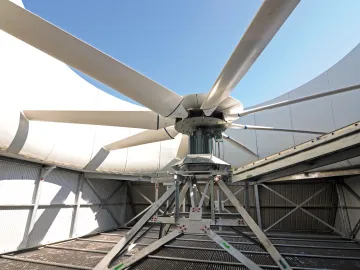
Across industries, operators are adopting cooling tower direct drive (CTDD) motor technology. In particular, permanent magnet (PM) direct drive motors are delivering measurable improvements in efficiency, cleanliness and maintenance reduction. The change is more than a component swap; it represents a new approach to cooling tower design that reduces operating costs, supports environmental goals and improves reliability. 

What do the beginnings of innovative businesses have in common? Certainly abstract attributes like creativity, intelligence and dedication all play a part, but in many cases the origins of great businesses have another, more concrete thing in common — a garage. Amazon, for instance, was originally founded by Jeff Bezos in his garage. Walt and Roy Disney made some of their first animated films in their uncle’s garage. And, last but not least, Steve Jobs, Steve Wozniak and Ronald Wayne designed the first Apple computer in a garage.
It’s been more than a decade since oil-free magnetic bearing centrifugal compressors hit the HVAC market. With unheard-of part-load energy efficiency and zero oil-related maintenance, these ultra-quiet machines are totally sustainable because there is no oil to change the heat transfer rates in the heat exchangers. Now there are more than 35,000 of them out there logging over 55 million run-hours, and all of them have an initial cost premium.
Ultrasonic leak detection has been used for a variety of applications ranging from energy reduction by locating compressed air leaks to quality assurance inspections such as locating wind noise and water leaks in automobiles. The secret to success is to understand the nature of what type of leak produces a detectible ultrasound and what does not, along with the techniques that can be used for effective leak identification. Once understood, there are instances where the limits of detection can be enhanced to help locate a leak in difficult situations.
This major mill complex upgraded their compressed air system and thereby eliminated $500,000 in annual rental compressor costs, reduced annual cooling-water costs by $500,000, and reduced electrical energy costs by $135,000 per year.
Pepco Energy Services’ (PES) Midtown Thermal Control Center (MTCC) in Atlantic City, New Jersey, sells chilled water and steam to multiple Atlantic City casinos, Boardwalk Hall and Pier Shops. PES is also responsible for stand-alone remote heating and cooling plants for the Atlantic City’s major casino’s as well as the Atlantic City Convention Center including its 2.4 Mw solar array.
The use of an industrial inhibited glycol and water mixture is recommended in most water chiller systems. Ethylene and Propylene are the two standard types of inhibited glycols commonly used. The main job of glycol is to prevent freezing of the process fluid and ensure consistent flow at the operating temperature. Inhibited glycols will also prevent formation of scale and corrosion while protecting metals such as brass, copper, steel, cast iron and aluminum. Water systems treated with an inhibited glycol will also be protected from algae and bacteria that can grow and degrade the fluid system performance. This brief provides ten basic tips for glycol users in water chilling operations.
Process cooling system applications experiencing constant production loads generating high process fluid temperatures are particularly good candidates to take advantage of low ambient temperatures. Low ambient temperatures can be used as a “free” energy source, replacing the electricity required to run refrigeration compressors, in what is known as a free-cooling chiller system.
Air compressors are very effective heaters. Over eighty percent of the energy input from the motor is converted into compression heat. That heat must be rejected from the compressor package in a way that maintains a variety of temperatures in a reliable manner. The laws of physics demand that the air temperatures go up with compression.
No matter what your application, there is a single formula for determining the size of chiller you need. There also industry-specific, rules-of-thumb for chiller sizing. These may vary depending upon the application. These guidelines and formulas may be used for sizing chillers for plastic process cooling applications.

Chillers

This article will make plants aware of the energy and water use differential between CHW systems…

Cooling Towers

Bayer Crop Science runs a 240-acre fertilizer production facility with areas for active ingredient…

Fluid Coolers

This article explores how air-cooled heat rejection systems are reshaping industrial cooling…

Dry Coolers

Adiabatic coolers are rapidly gaining ground in plastics processing as manufacturers seek…

Water Filtration

Field-erected evaporative “wet” cooling towers, combined with heat exchangers, are an economical…

Heat Exchangers

Free cooling offers a highly efficient alternative to chiller-based cooling, but its success…

Cooling Controls

The customers wanted to be able to monitor their system from a control room. They wanted to be able…